Looking for Christian inspirational stories that lift the heart without preaching at it? The Second Net is a short story of faith after loss — about a fisherman, a storm, and the quiet courage to cast your net one more time.
The Second Net
Marcos had fished the waters off Greyhook Bay for thirty years, and he knew the sea the way other men knew their own wives — its moods, its mercy, and its temper.
His boat was called Mercy, a name his father had painted on her stern in white letters when Marcos was still a boy. Every morning before dawn, he would push her off the shingle, row past the breakwater, and cast his net into the dark water, praying the same short prayer his father had taught him: Lord, give me enough for today, and let me be grateful for it.
Most days, the sea answered.
Then came the storm.
It arrived on a Tuesday evening without the courtesy of a warning — black clouds rolling in off the horizon, wind tearing at the rooftops, waves climbing the harbour wall like thieves. Marcos stood in his doorway and watched the water take his boat. He watched the Mercy rise on a wave, hang for a terrible moment against the sky, and then come down on the rocks and break apart like a dropped plate.
By morning, all that was left of her was scattered timber on the shingle.
The village expected Marcos to rebuild. He was a fisherman; fishermen rebuild. But Marcos sat on the harbour wall for three days, staring at the grey water, and did not lift a hammer.
“The sea gave me thirty years,” he said to his neighbour, old Tomas, “and then it took everything in one night. What kind of God does that?”
Tomas did not argue. He had buried a wife and two sons, and he knew better than to hand a grieving man an easy answer. He simply sat down beside Marcos on the wall and said, “I don’t know. But I know you are still here. And I know the tide still comes in.”
Marcos had no boat, no money for timber, and no heart for the work. So he did the only thing he could do: he took up his needle and twine, and he began mending other men’s nets.
Day after day, he sat in the harbour shed, his fingers working the knots, patching the tears other fishermen had no time to fix. He charged almost nothing. The men would leave a basket of bread, a jar of olives, a few coins on the bench — and Marcos would nod, and keep mending.
Weeks passed. Then months. The winter came and went, and the spring tides returned, and Marcos was still in the shed, mending nets for boats that were not his own.
One morning, a woman named Ruth came to the shed. She was eighty years old, bent like a reed in the wind, and she carried a set of keys in her hand.
“My husband’s boat has sat in the boathouse since he died,” she said. “Six years now. She is called Grace. She needs caulking and a new sail, but her hull is sound. I have been waiting for the right fisherman.”
Marcos stared at her. “Why me?”
“Because you have spent five months mending everyone else’s nets,” Ruth said, “and never once asked the sea for anything in return. That is the kind of man my husband would have trusted with his boat.”
Marcos wanted to refuse. His hands trembled at the thought of open water. What if the storm came again? What if the sea took this boat too?
But the next morning, before dawn, he walked to the boathouse, and he found the Grace waiting there like an answer to a prayer he had stopped praying.
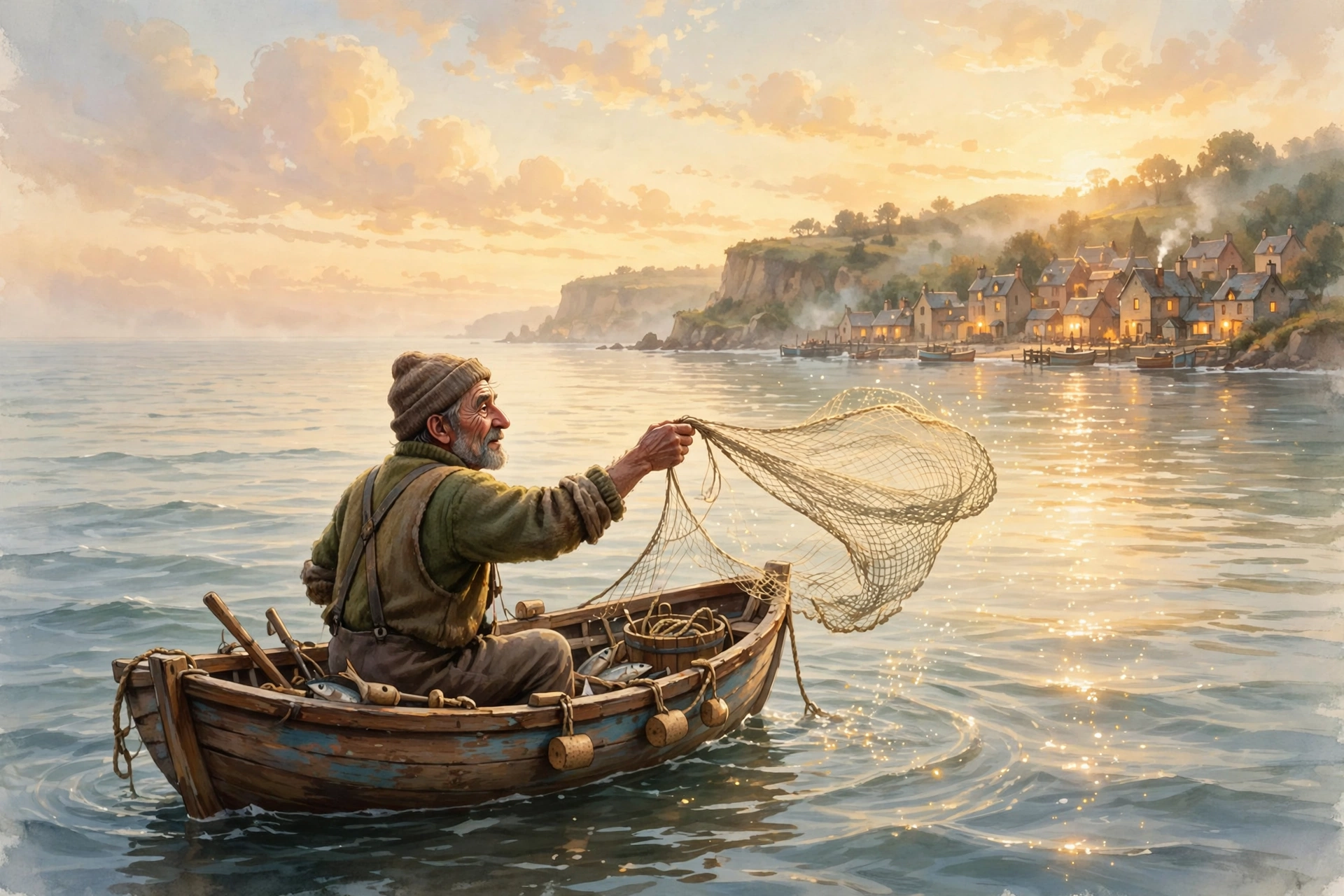
He pushed her off the shingle, rowed past the breakwater, and cast his net into the dark water — the first cast he had made in half a year. And as the net sank, he whispered the old prayer, the one his father had taught him: Lord, give me enough for today, and let me be grateful for it.
The catch that morning was not a miracle. It was modest — enough for his table, and a little to share with Ruth. But as he rowed back toward the harbour, Marcos saw something that stopped his oars mid-stroke.
The whole village was waiting on the shingle.
Men, women, children — all the fishermen whose nets he had mended, all the families he had fed with his quiet work — standing together in the dawn light, watching for his return.
That was when Marcos understood. The sea had taken his boat, but it had never taken his calling. A light kept burning through the darkest night is not put out by one storm — and a man who keeps serving others, even with empty hands, is never truly empty.
He had cast his net again. And the sea, in its own way, had given him back far more than fish.
The Moral of the Story
Faith is not the belief that the storm will never come — it is the courage to cast your net again after it has. Marcos lost his boat, but he never lost his calling: while he waited, he served others, mending their nets with empty hands. And when the time came, the sea returned his work a hundredfold — not with a miracle catch, but with a village standing on the shore, waiting for him to come home.
Think About It
- What “boat” have you lost — a job, a dream, a relationship — and what would it look like to cast your net one more time?
- While you wait for your own breakthrough, whose “nets” could you be mending?
- How would your faith change if you stopped asking God to prevent the storm, and started trusting Him to meet you after it?
Frequently Asked Questions
What is the moral of “The Second Net”?
The moral is that faith means casting your net again after loss. Marcos discovers that serving others while he waits — mending their nets with empty hands — prepares the way for his own restoration, which arrives not as a miracle but as a community that never stopped believing in him.
What makes a good Christian inspirational story?
A good Christian inspirational story shows faith working in ordinary life — not through grand miracles, but through small, steady choices: praying when it is hard, serving when you have little, and trusting again after disappointment. The lesson is felt through the characters, not preached at the reader.
Why do Christian inspirational stories still matter today?
Because loss, disappointment, and waiting are universal. Stories like “The Second Net” remind us that God often works through patient faithfulness and the kindness of others — a truth that speaks just as clearly today as it did centuries ago.