Some Christian stories are about miracles that arrive in a moment. This one is about a prayer that took seven years to answer — and the woman who kept lighting a candle for it anyway.
The Second Candle
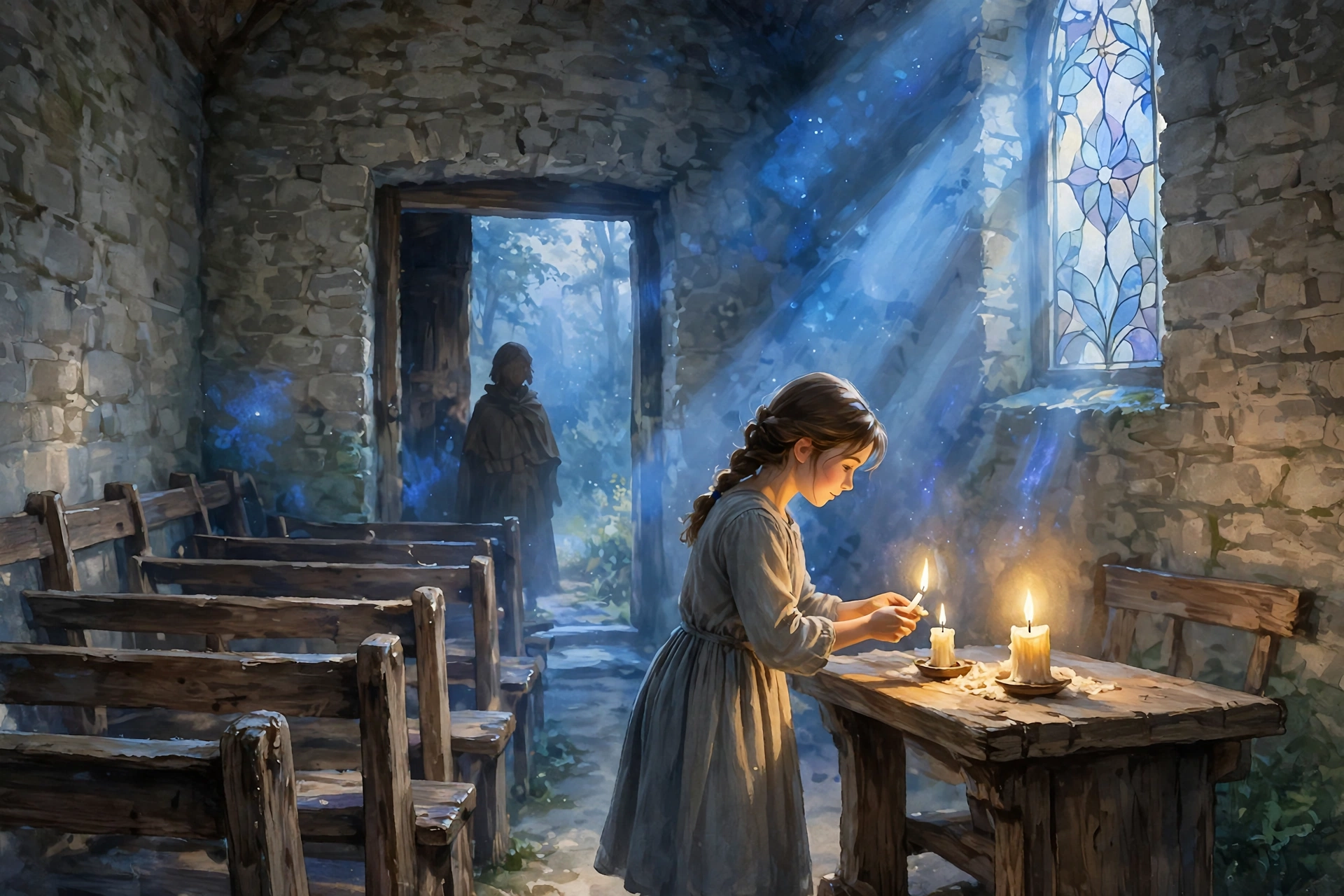
Every Sunday for seven years, Ruth walked to the little stone chapel at the edge of Willowford and lit two candles.
The first candle was for thanks. The second candle was for her brother, Daniel — for the phone call she was still waiting for, for the door that had closed between them one winter night, for the words she wished she had said before he drove away.
The chapel was small and old, with wooden pews worn smooth by generations of hands and a window of blue glass that turned the morning light the colour of deep water. Ruth always sat in the same place: the third pew from the front, on the left, where her grandmother had sat for fifty years before her.
Her grandmother had taught her the two-candle habit. “One for what God has given,” the old woman used to say, pressing a coin into Ruth’s palm, “and one for what you are still trusting Him for. Never light only one. Gratitude and hope belong together.”
For seven years, Ruth kept the habit. She lit the first candle easily — for her health, for her work at the bakery, for the neighbours who had become family. But the second candle was harder. Some Sundays she stood before it with tears in her eyes, wondering if she was lighting it for nothing. Prayers that seem to go unanswered have a way of wearing down even the most patient heart.
Then one grey November morning, as Ruth struck the match for the second candle, the chapel door opened behind her.
She did not turn around at first. Visitors came and went; the chapel was open to anyone who needed quiet. But then she heard footsteps stop behind her pew, and a voice she had not heard in seven years said, very quietly, “You still sit in Grandma’s seat.”
Ruth turned. Daniel stood there, thinner than she remembered, his coat wet from the rain, his hands empty at his sides. He looked like a man who had practised this moment a hundred times and still did not know how to begin it.
“I drove past Willowford a dozen times,” he said. “Every time I told myself next month. Then I remembered what Grandma used to say — that a door is only closed until someone knocks.”
Ruth stood up slowly. Seven years of silence stood between them, heavy as stone. Then she did the only thing that made sense: she took the second candle from its holder, still burning, and held it out to him.
“This one was yours,” she said. “Every Sunday. I never stopped lighting it.”
Daniel stared at the small flame, and something in his face broke — not with grief, but with relief, the way a dam breaks when the water finally finds its way through.
“I thought you’d forgotten me,” he whispered.
“I thought you’d never come back,” Ruth said. “But faith isn’t about knowing when. It’s about keeping the light burning while you wait.”
They sat together in the third pew that morning, the way they had as children, and the blue window light fell across them both. The first candle burned for thanks. The second candle — the one for Daniel — had finally done its work.
And from that Sunday on, Ruth lit three candles: one for what God had given, one for what she was still trusting Him for, and one — the newest — for the brother who had come home.
The Moral of the Story
Faith is not proved by how quickly a prayer is answered, but by how faithfully we keep waiting. Like a shepherd who kept counting his blessings even in the hardest season, Ruth discovered that the years of waiting were not wasted — they were the very thing that made the homecoming possible. Keep your candle lit. Some prayers simply take longer to find their way home.
Think About It
- Is there a prayer — or a hope — you have been carrying for a long time? What keeps you holding on to it?
- Who in your life might be waiting for you to knock on a door that has been closed too long?
- How could pairing gratitude with hope, the way Ruth lit two candles, change the way you face a difficult season?
Frequently Asked Questions
What is the moral of “The Second Candle”?
The moral is that faith means keeping hope alive even when answers are slow. Ruth lit a candle for her brother every Sunday for seven years, and her patient faith — like a merchant who finally found his way back home — shows that waiting is not the same as giving up.
Why do people read Christian stories?
People read Christian stories because they speak to real struggles — forgiveness, waiting, hope, and homecoming — through simple, memorable characters. A good Christian story does not preach; it shows faith lived out in ordinary life, one small choice at a time.
What makes a good Christian story for adults?
A good Christian story for adults deals honestly with doubt and delay, not just with happy endings. The best ones, like the parables, end with a truth you can carry into your own life — here, that gratitude and hope belong together, lit side by side.