Looking for a short story about letting go? The Open Hand is a story about Ruth, a widow who keeps her husband’s woodworking shop untouched for three years — until a young apprentice knocks on her door and teaches her that letting go is not losing what you love, but making room for it to live on.
The Open Hand: A Short Story About Letting Go
For three years after Elias died, Ruth kept his workshop exactly as he had left it.
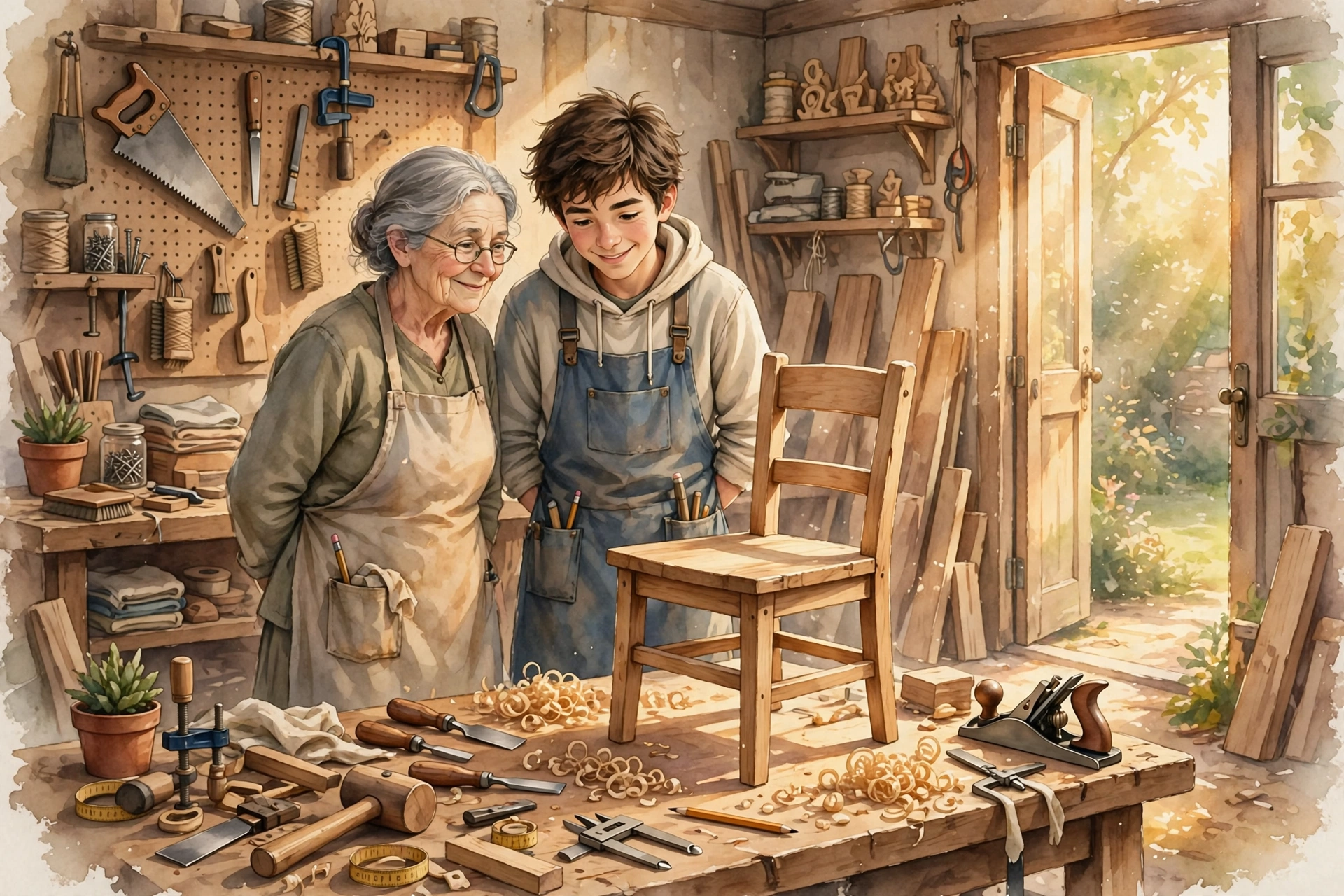
The workshop stood behind their small stone house, its door latched but never locked. Inside, the air still smelled of sawdust and linseed oil. Elias’s chisels hung in a neat row above the bench, and on the workbench lay the chair he had been making when his heart stopped — one leg half-shaped, waiting for hands that never came back.
Ruth dusted the bench every Sunday. She swept the floor, oiled the tools so they would not rust, and never moved a single thing. To move something would be to admit he was truly gone.
The villagers understood, at first. Then they began to ask: the school needed a bookshelf, a young carpenter offered to buy the idle tools. Ruth thanked each of them and said no. The workshop was not for sale and not for use. It was a room full of Elias, and she would keep it whole.
One spring morning, a boy of perhaps fourteen knocked on her door — thin and earnest, sawdust on his sleeves from the timber yard. “Mrs. Ruth, my name is Noah. I want to learn to make things with wood. Everyone says your husband was the best carpenter in the valley. Would you teach me?” Ruth felt something close in her chest. “There is nothing to teach here,” she said. “The shop is closed.”
“Then could I just look at it?” Noah asked. “Just once. I have never seen a real workshop.” Ruth almost refused. But something in the boy’s face — the hunger to learn, the look Elias used to get over a new piece — made her lift the latch.
Inside, Noah moved slowly, reverently, the way a person moves in a church. He touched nothing. He only looked: at the chisels, at the half-finished chair, at the shavings on the floor. “He was in the middle of this one,” he said. “Yes,” Ruth said. “It is a beautiful chair,” Noah said. “It is a shame it will never be finished.”
That night, Ruth could not sleep. The boy’s words stayed with her like a splinter under the skin. Three years she had kept the workshop perfect and untouched — and now she saw what she had actually been doing. She had not been keeping Elias alive. She had been keeping his work from living.
The next morning, she unlatched the workshop door and left it open. When Noah came back, as she knew he would, she handed him Elias’s apron. “The apron is too big for you,” she said, “and the chisels will feel strange in your hands. That is how learning feels. Come on Tuesdays and Thursdays. We will finish the chair first.”
Week by week, the workshop woke up: sawdust on the floor again, linseed oil in the air. Noah was clumsy at first, and Ruth was impatient, and they argued over cuts and joints. But slowly, the chair took shape — the last leg turned, the joints fitted, the seat polished until it shone.
On the day they finished it, Ruth ran her hand over the smooth wood and felt something she had not felt in three years: not grief, exactly, but something softer, like ground thawing in spring. “It is yours,” she said. “Take it home. Sit in it. That is what a chair is for.”
Noah stared at her. “But it was his,” he said. “Yes,” Ruth said, smiling for the first time in years. “And now it is finished. A thing is not kept by hiding it. It is kept by being used, and loved, and passed on. That is how Elias lives now — in every chair this shop will ever make.”
That autumn, Ruth nailed a new sign above the workshop door: RUTH & NOAH — CARPENTERS. The villagers came with broken chairs, and the shop hummed again. Elias’s chisels were in young hands now — sharp, used, and loved.
Ruth still dusted the bench on Sundays. But she no longer kept the room frozen in time. She had learned grief’s hardest lesson: an open hand holds more than a closed fist ever could.
The Moral of the Story
Letting go is not losing what you love. Ruth kept her husband’s workshop frozen for three years, believing that holding on tight was the same as keeping him close — but a chair left unfinished serves no one. When she finally opened her hand and let a young apprentice finish the work, Elias’s craft lived again. What we love stays with us not by being locked away, but by being used, shared, and passed on.
Think About It
- Is there something you are holding on to so tightly that it can no longer grow or be used?
- What would it look like to let it go — not to throw it away, but to let it live in a new way?
- Has letting go of something ever brought you something unexpected in return?
Frequently Asked Questions
What is the moral of the story “The Open Hand”?
The moral is that letting go is not losing what you love. Ruth believes keeping her husband’s workshop untouched will keep him close, but she learns that a thing is kept by being used, shared, and passed on — not by being locked away. An open hand holds more than a closed fist.
What does this story teach about letting go?
It teaches that letting go is an act of love, not of forgetting. Ruth does not stop loving Elias when she opens the workshop; she gives his craft a future. Letting go means releasing your grip on how things were so that what mattered can keep living in a new form.
How do you let go of something you love?
Start small, as Ruth does: open the door, let one person in, finish one unfinished thing. You do not have to give everything away at once. Letting go is a practice — one small opening at a time — and each opening makes the next one easier.
Why is letting go so hard?
Because holding on feels like loyalty, and letting go feels like betrayal. Ruth fears that moving a single tool means admitting Elias is gone. But grief and love are not the same thing: you can grieve what was lost and still let what remains be used, loved, and carried forward.
More Stories You’ll Love
- The Patient Light — a short story about patience and tending the light while you wait.
- The Second Chance — a story about second chances and the courage to begin again.
- The Tin Lunchbox — a story of kindness found in the most ordinary place.