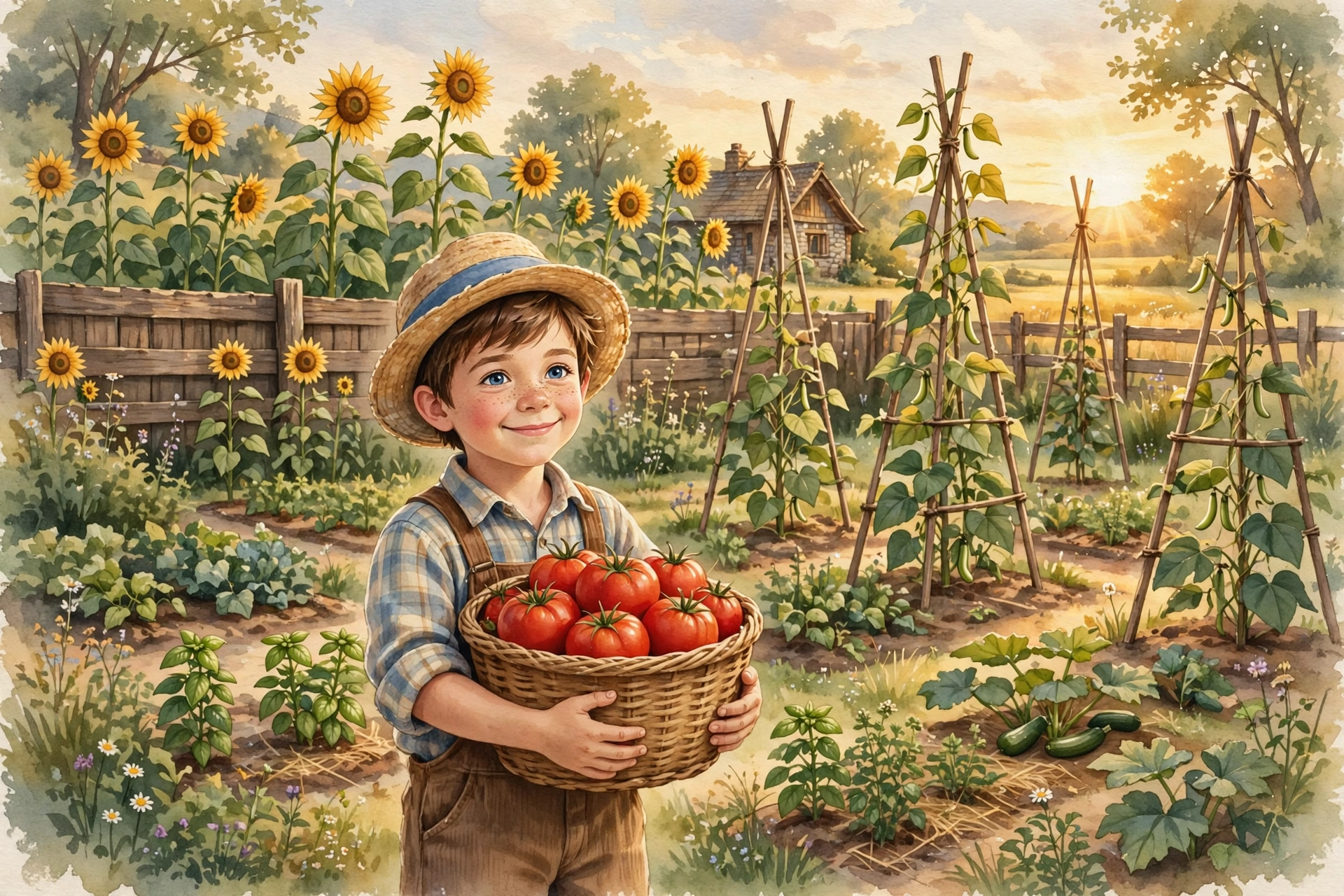
Looking for moral stories for kids that teach a real lesson without sounding like a lecture? The Garden of Borrowed Seeds is a gentle story about a boy, a patch of empty soil, and the promise that turned a handful of borrowed seeds into a garden for a whole street.
The Garden of Borrowed Seeds
Arlo was nine years old, and he had a problem. Behind his house there was a small patch of bare earth, and every spring the school held a garden show — and every spring, Arlo watched the other children carry in baskets of tomatoes and sunflowers and marrows while he carried in nothing at all.
“Seeds cost money,” his mother said gently, “and this year money is tight. Maybe next year.”
Arlo nodded, but he did not give up. The next morning, he knocked on Mrs. Patel’s door.
“Mrs. Patel,” he said, “could I borrow three tomato seeds? I promise I will give them back.”
Mrs. Patel laughed — not unkindly, but the way grown-ups laugh when a child says something wonderfully serious. “Seeds don’t come back the way you lent them, Arlo. A seed grows into a plant. You can’t un-grow a tomato.”
“Then I’ll bring you back three seeds from the tomatoes I grow,” Arlo said. “And a tomato too, if you’ll let me.”
Mrs. Patel studied his face for a long moment. Then she went to her kitchen drawer and counted out three small seeds into his palm. “A promise is a promise,” she said. “I’ll hold you to it.”
Arlo knocked on more doors after that. Old Mr. Barlow gave him five sunflower seeds and a stern warning: “Sunflowers are stubborn. They need water every day, even when you’re tired.” Mrs. Okafor gave him bean seeds wrapped in a twist of paper. Mr. Davies, who grew the biggest marrows on the street, gave him two marrow seeds and a wink. “These ones are champions,” he said. “Don’t tell the others.”
By the end of the afternoon, Arlo’s pockets were full — and so was his notebook, where he had written down every promise.
Then the hard part began.
Arlo dug the patch behind his house until his arms ached. He planted each seed at the depth Mr. Barlow had taught him, pressed the soil down gently, and watered it with a chipped blue jug. Every morning before school, he watered. Every evening after homework, he weeded. When a late frost threatened the young plants, he covered them with old sheets.
His friends teased him. “Why are you working so hard for seeds that aren’t even yours?” they asked.
“They will be mine when I’ve kept my promises,” Arlo said.
Summer came, and the patch turned into something the whole street stopped to look at. The tomato plants grew taller than Arlo himself, heavy with red fruit. The sunflowers stood like golden sentries along the fence. The beans climbed their poles in thick green ropes, and the marrows swelled to the size of small dogs.
When harvest day arrived, Arlo did not run to the garden show first. He went to Mrs. Patel’s door with a basket: three tomato seeds in a small envelope, and the biggest, reddest tomato from the vine.
“A promise is a promise,” he said.
Mrs. Patel took the tomato and held it up to the light, and her eyes went shiny. “Arlo,” she said, “I have grown tomatoes for forty years, and no one has ever brought me back a seed.”
He went to every door that day — sunflower seeds for Mr. Barlow, beans for Mrs. Okafor, marrow seeds for Mr. Davies — and at every door, he left a little of the harvest too. And at every door, someone pressed a gift into his hands in return: a jar of jam, a bunch of mint, a packet of next year’s seeds, saved specially.
By the time he reached the garden show, his basket was lighter than everyone else’s. But when the judges asked what he had grown, Arlo told them the whole story.
He did not win first prize. He won something better. The judges gave him the Gardener’s Cup, for the garden that had done the most good — because, they said, kindness is a chain, and Arlo’s garden had linked the whole street together.
That autumn, five new gardens appeared on Arlo’s street. And in every one of them, the first seeds planted were the ones Arlo had given back.
The Moral of the Story
A promise kept is worth more than the thing you borrowed. Arlo had no money for seeds, but he had something better: his word. Because he kept his promises, his little garden grew into something that fed a whole street — and one small act of honesty can open a gate to friendships, trust, and gardens you never expected.
Think About It
- Have you ever borrowed something? What did you do to make sure you returned it in good shape — or better?
- Why do you think the neighbours trusted Arlo with their seeds, and how had he earned that trust?
- What is one promise you could keep this week that would make someone else’s day better?
Frequently Asked Questions
What is the moral of “The Garden of Borrowed Seeds”?
The moral is that keeping your promises matters more than what you own. Arlo borrows seeds he cannot afford, works hard to grow them, and returns every seed — and his honesty turns one small garden into a gift for the whole street.
Why are moral stories good for kids?
Moral stories for kids teach honesty, kindness, and responsibility through characters children can relate to. Instead of being told what to do, children watch a character make a choice — and feel for themselves why the right choice matters.
What makes “The Garden of Borrowed Seeds” a good bedtime story?
It is gentle, hopeful, and full of small wonders — seeds sprouting, sunflowers growing taller than a boy, neighbours sharing jam and mint. The lesson lands softly, and the ending leaves children smiling, which is exactly what a bedtime story should do.