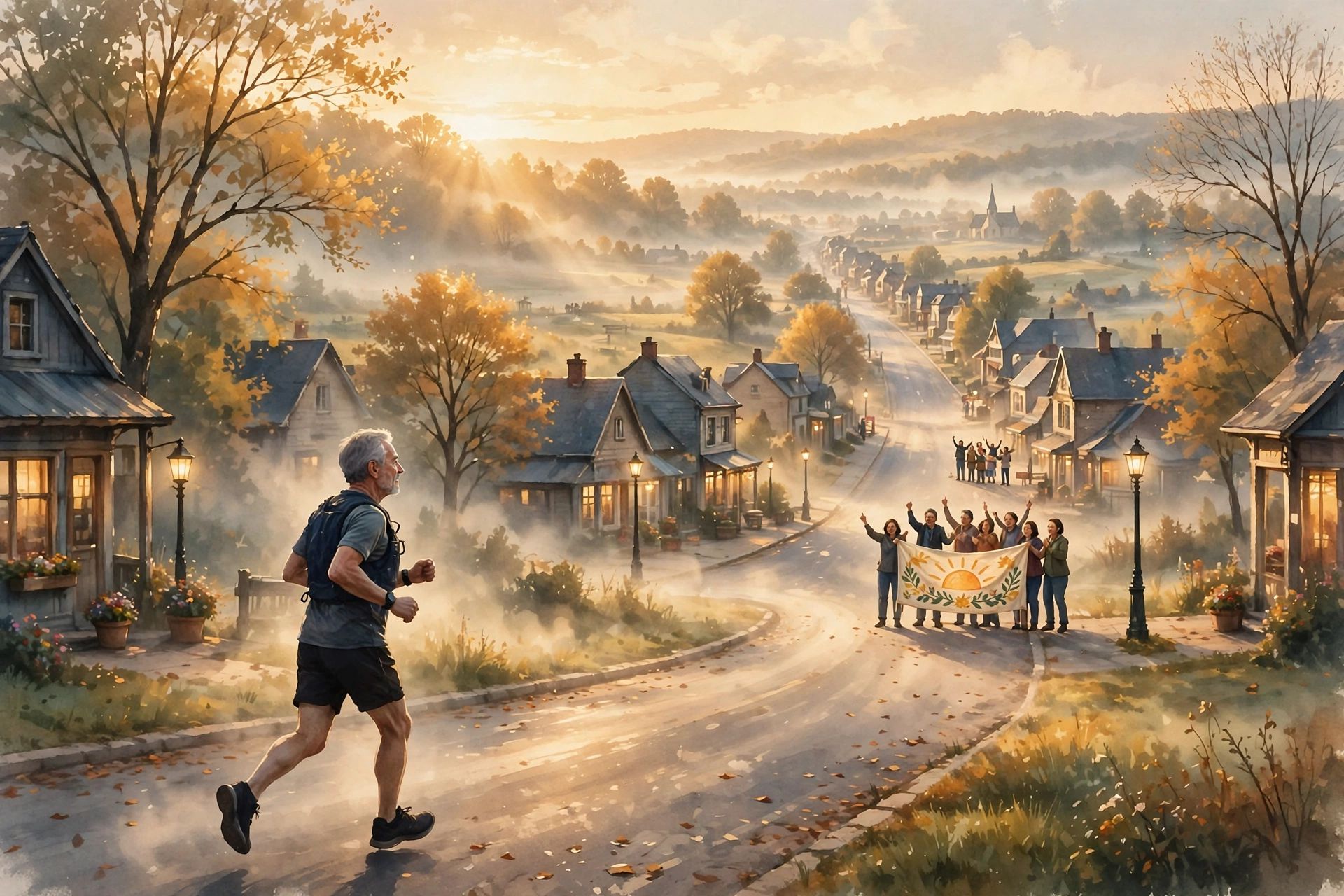
Some of the best inspirational true stories are not about champions standing on podiums. They are about ordinary people who refuse to quit — like Daniel Marsh, a 52-year-old bus driver who made a promise to his late wife and kept it one slow, stubborn mile at a time. His is a story of a second chance found not in a single dramatic moment, but in hundreds of quiet mornings before dawn.
The Man Who Ran at Dawn
Daniel Marsh drove the number 14 bus through the town of Alderwick for twenty-three years. He knew every pothole on the route, every regular passenger by name, and every shortcut the timetable pretended did not exist. What he did not know, at fifty-two, was how to run.
He had never run anywhere in his life. Running was for other people — younger people, fitter people, people whose knees did not complain on cold mornings.
But three months after his wife, Ruth, passed away, Daniel found a folded piece of paper in her bedside drawer. It was a marathon entry form, half filled in — his name in her neat handwriting, his age, his address. At the bottom she had written, in pencil: For Dan. You always said one day. One day is now.
Daniel sat on the edge of the bed for a long time. Then he folded the form, put it in his pocket, and signed up.
His first run lasted four minutes. He jogged to the end of his street, bent double with his hands on his knees, and walked home feeling foolish. The second morning he made it to the corner shop. The third, to the church. By the end of the first week, he could run for ten whole minutes without stopping — and he felt like a man who had climbed a mountain.
He ran before dawn, when the town was still asleep. At 4:30 every morning, his alarm went off, and every morning his body begged him to stay in bed. Every morning, he thought of the folded form in his drawer. And every morning, he got up.
One rainy Tuesday in October, everything went wrong. His knee gave way on a wet kerb, and he went down hard, scraping his palms raw on the pavement. He sat there in the rain, fifty-two years old, cold and soaked, and thought: This is ridiculous. I am too old. I should stop.
He nearly did. For three days he did not run. On the fourth morning, he found himself standing at the window, watching the empty street, and he realised something: the running had never really been about the marathon. It was about the promise. And a promise does not expire just because keeping it is hard.
He laced up his trainers and went out again — slower, more careful, but out.
Word got around Alderwick, as word always does in a small town. First it was Mrs. Patel from the corner shop, leaving a bottle of water on her doorstep for him each morning. Then the postman started waving him on. Then a group of teenagers, out far too early themselves, began jogging alongside him for a stretch, laughing and calling him “the dawn man”. By spring, half the street seemed to be awake at 4:30, just to cheer him past.
On race day, Daniel stood at the starting line in a borrowed running vest, surrounded by thousands of people half his age. The first ten miles were hard. The next ten were harder. At mile twenty, his legs felt like they belonged to someone else, and the voice in his head — the same one from that rainy Tuesday — whispered that he could stop now and no one would blame him.
But then he heard it: his name, called out from the crowd. Mrs. Patel. The postman. The teenagers. Half of Alderwick had come, standing behind the barriers with a hand-painted banner that read: GO ON, DAWN MAN.
Daniel Marsh finished the marathon in five hours and forty-one minutes. He was not first. He was not even close to first. He was, in fact, one of the very last runners to cross the line — and the crowd that was still there, hours after the winners had gone home, cheered louder for him than for anyone else that day.
That evening, Daniel took the folded entry form from his drawer and wrote on the back of it, in his own handwriting: Kept. Love, Dan. Then he put it back — next to Ruth’s photograph — and went to bed early. His alarm was set for 4:30.
After all, he had a morning run to do.
The Moral of the Story
True inspiration is rarely about winning. Daniel Marsh never stood on a podium, never broke a record, and never ran fast — but he kept a promise, one dawn at a time, long after quitting would have been easier. The most powerful inspirational true stories are the ones like his: ordinary people doing the hard thing slowly, stubbornly, and without applause. If you want to change your life, do not wait for a grand moment. Start small, start early, and keep going when the road gets long — because the finish line belongs to everyone who refuses to stop.
Think About It
- What promise have you been putting off — and what is the smallest first step you could take tomorrow morning?
- When have you wanted to quit something worthwhile, and what kept you going?
- Who in your life is quietly doing something hard every day without applause — and how could you cheer them on?
Frequently Asked Questions
Are inspirational true stories based on real people?
Many inspirational true stories draw on real-life experiences — ordinary people facing illness, loss, or failure and finding the strength to carry on. Daniel’s story reflects a pattern found in countless real accounts: a promise, a slow start, and a finish that mattered more than the time it took.
Why do inspirational true stories motivate us?
They motivate us because the heroes are people like us — not superhuman, just stubborn. When we see a 52-year-old bus driver keep a promise one dawn at a time, we start to believe that our own goals might be possible too.
What makes a true story inspirational?
A true story becomes inspirational when someone faces a real obstacle and refuses to quit. It is not the size of the achievement that matters, but the honesty of the struggle — and the hope it leaves behind for the rest of us.