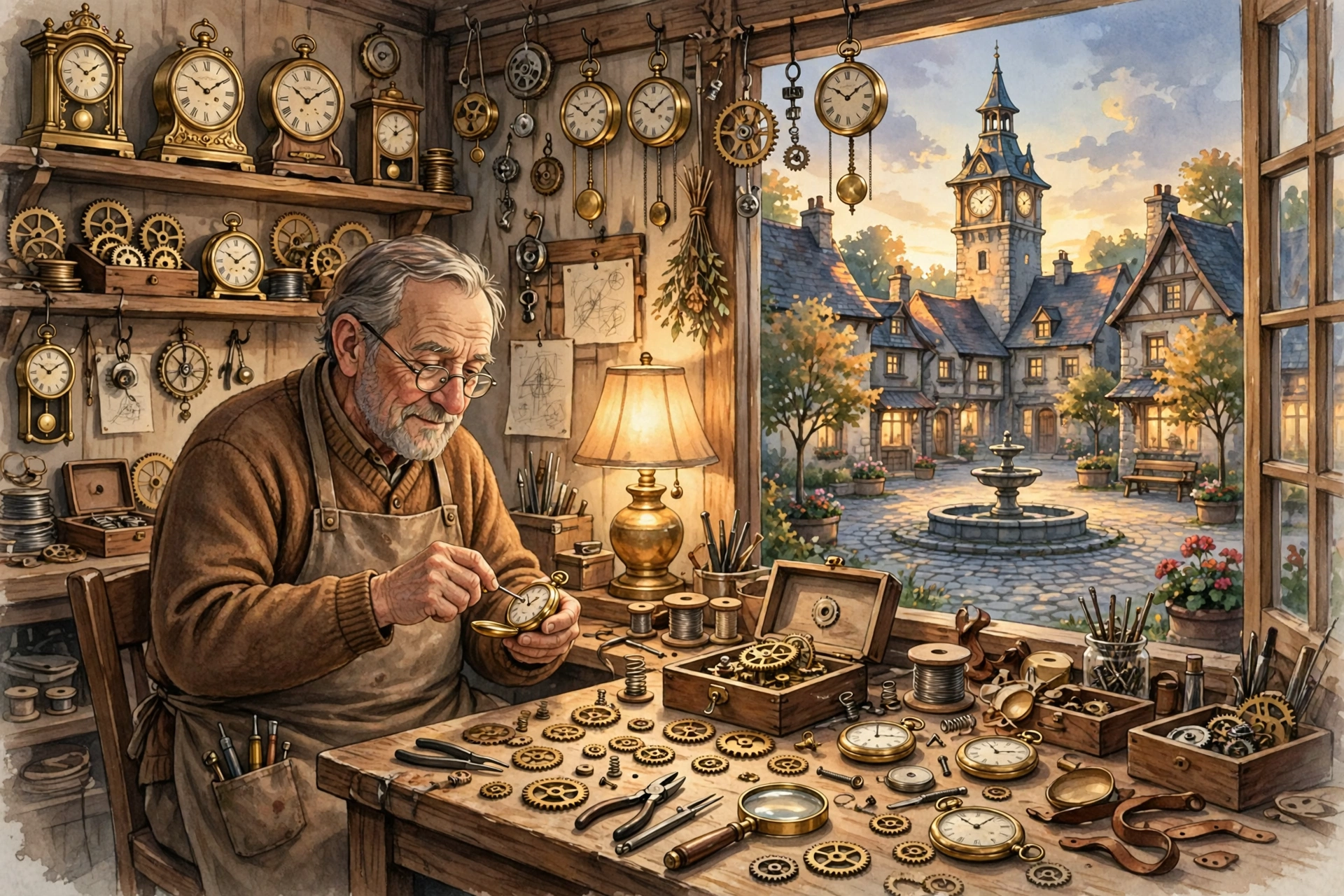
Looking for a story with a lesson that stays with you long after the last line? The Clockmaker’s Hour is a short moral story about a village clockmaker, a rich man who tries to buy time, and the quiet truth that every hour is a gift — and, as one old piano tuner learned, it is never too late to begin again.
The Clockmaker’s Hour
In the village of Ashford, every clock that mattered had passed through the hands of Elias Brann. He had mended the tower clock on the square, the railway station clock, and the little brass clock in the baker’s window. His shop was small and smelled of oil and wood shavings, and above the door hung a sign he had carved himself: Time mended here.
Elias was not a rich man. He charged what people could afford, and when they could afford nothing, he charged nothing at all. “A clock that stops is a day that stops,” he would say, and he meant it.
One autumn morning, a carriage stopped outside his shop — the first carriage Ashford had seen in years. Out stepped a man in a fine coat, with a gold watch chain across his waistcoat and the air of someone used to being obeyed. His name was Aldous Crane, and he owned half the county.
“Are you the clockmaker?” Crane asked.
“I am,” said Elias, wiping his hands on his apron.
“Good. I have a proposition.” Crane set a heavy purse on the counter. It clinked. “I am a busy man, Brann. My days are too short. I want you to make me more time.”
Elias blinked. “Sir?”
“You mend clocks,” Crane said. “So mend mine. Make my days longer. Slow the hands. Add an hour, or two, to every day. I will pay whatever you ask.”
Elias looked at the purse, then at the man, and smiled the gentle smile he reserved for clocks that had been wound too tight.
“I cannot do that, sir,” he said.
Crane’s face darkened. “Everything has a price. Name yours.”
“Not this,” Elias said. “A clock can be mended, but time cannot be bought. The hour you spend is the hour you spend — no more, no less.”
Crane laughed, though there was no warmth in it. “Then you are a poor businessman, clockmaker. And a fool.”
He left the purse on the counter and walked out, slamming the door behind him.
That evening, as Elias was closing the shop, he noticed something on the floor near the counter: a small gold pocket watch, dropped from Crane’s waistcoat. It was beautiful — and it had stopped. Elias wound it gently, and it ticked back to life.
The next morning, Elias walked up the long hill to Crane’s great house and knocked on the door.
“You dropped this,” he said, holding out the watch.
Crane stared at it, then at the old clockmaker. “You walked all the way up here to return it? You could have sold it. It is worth more than your shop.”
“It is yours,” Elias said simply. “And a watch that stops is a day that stops — even for a rich man.”
For a long moment, Crane said nothing. Then he did something no one in the county had ever seen him do: he sat down on his own front step, and he asked Elias to sit beside him.
“Tell me something, clockmaker,” he said quietly. “If time cannot be bought, what is it for?”
Elias looked out over the valley, where the village lights were beginning to glow.
“Time is for spending,” he said. “Not on more of itself — on the things that matter. A morning with your daughter. An hour mending something broken. A minute telling the truth. That is the whole secret, sir. You do not need longer days. You need fuller ones.”
Crane turned the watch over in his hands. It ticked steadily, patiently, like a small heart.
“I have spent forty years buying things,” he said. “I have never once bought an hour I enjoyed.”
“Then start today,” said Elias. “There is still time. There always is — until there isn’t.”
Crane never returned to the clockmaker’s shop to buy time. But the following spring, the villagers noticed something strange: the great house on the hill had its windows open, and a rich man in a fine coat was out in the garden, planting roses with his daughter, laughing like a boy. And every morning, without fail, he wound his little gold watch — and listened to it tick, as if it were the most precious sound in the world.
For the first time in forty years, Aldous Crane was not in a hurry.
The Moral of the Story
Time cannot be bought, borrowed, or saved for later — it can only be spent. Aldous Crane owned half the county and still believed his days were too short, until a clockmaker who owned almost nothing showed him the truth: a longer life is not measured in hours, but in how fully each hour is lived. You do not need more time. You need to spend the time you have on what matters — and, like the quiet chain of kindness in The Lantern Keeper, a single honest hour can light the way for years to come.
Think About It
- If you could buy one extra hour a day, what would you honestly spend it on?
- What is one thing you keep postponing — and what would it cost to do it this week?
- How would your days change if you treated each hour as something to spend well, not something to save?
Frequently Asked Questions
What is the lesson of “The Clockmaker’s Hour”?
The lesson is that time cannot be bought — it can only be spent. A rich man tries to purchase longer days, but a humble clockmaker teaches him that fuller days, not longer ones, are what make a life rich.
Why are stories with a lesson good to read?
Stories with a lesson let you watch a character learn something the hard way — like Crane discovering that wealth cannot buy time — so the lesson feels earned and stays with you far longer than advice alone.
What makes a good story with a moral?
A good story with a moral pairs a relatable character with a real struggle and ends with a lesson that feels discovered, not preached. The best ones, like the classics, stay with you long after you finish reading.