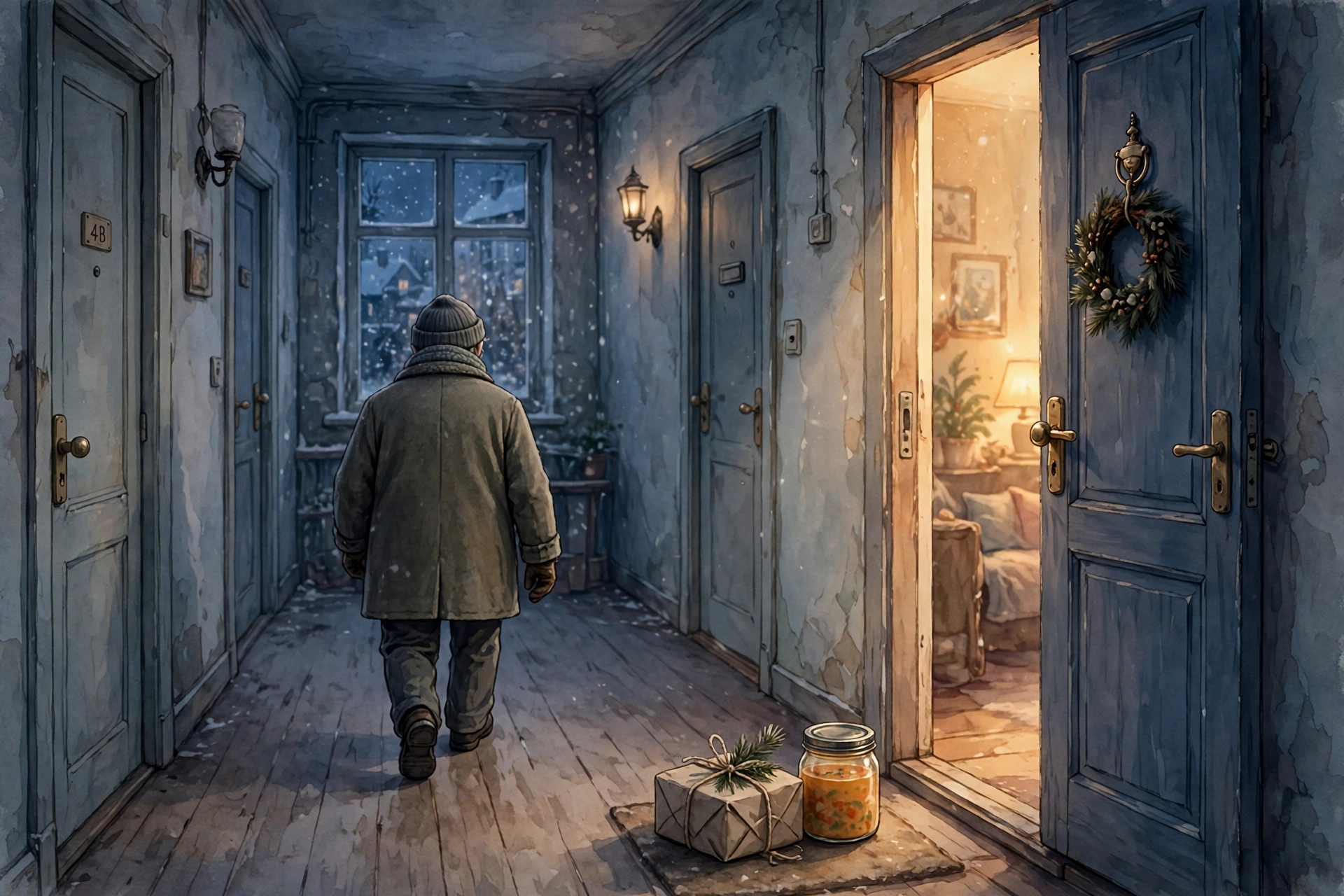
Why is it important to be kind? It is a question we usually ask in grand moments — after a tragedy, or when someone famous speaks about compassion. But kindness rarely announces itself. Most of the time it arrives quietly, in a hallway, on an ordinary evening, from someone who expects nothing in return. The Quiet Neighbour is a short inspirational story about exactly that kind of kindness — and about how a small act, offered at the right moment, can keep a person going.
The Quiet Neighbour
Mara had lived in flat 4B for three years, and in all that time she had never once heard her neighbour in 4A speak. She knew his routines: slippers at six, the kettle at six-fifteen, the front door at seven as he left for the park with his walking stick. She did not know his name.
She had tried, once, in her first month, knocking with a plate of biscuits. The door had opened a crack, tired eyes had looked out, and a low voice had said, “No, thank you,” before it closed again. Some people, she decided, simply preferred to be left alone.
That winter, Mara’s own life narrowed. Her hours at the bookshop were cut, her mother fell ill in another city, and her evenings grew long and silent. She began to understand how a person could live among dozens of neighbours and still feel entirely alone.
One bitter January evening, she came home to a small parcel outside her door: brown paper, tied with string, no note. Inside was a jar of homemade soup and a slice of bread in a clean cloth.
Mara stared at it for a long time. She had told no one she had skipped lunch that day, or that her heating had been off since morning to save money. No one could have known — except someone who had noticed her thin shopping bags, or how she hurried past the bakery without stopping.
The next evening brought soup and an apple; the evening after, a small pot of stew. Mara left offerings in return — a slice of cake outside 4A, flowers from the market, a note saying only, “Thank you. — 4B.”
The notes were never answered, but the parcels kept coming, and slowly Mara changed too: she held lift doors, asked after the caretaker, and smiled at strangers on the bus, having learned how much a small warmth can matter to someone cold inside.
Then, in March, the parcels stopped. After three empty evenings, worried in a way she could not explain, Mara knocked on 4A.
This time the door opened wider. An old man stood there, thinner than she remembered, leaning on his stick. Behind him his flat was dark and cold, and on the table lay a half-finished letter and a photograph of a young woman who was unmistakably his daughter.
“Are you all right?” Mara asked.
Very slowly, he smiled — the first she had ever seen from him. “I was ill,” he said. “Nothing serious. But I could not cook, and I thought — if I stopped, you might worry.”
“I did worry,” Mara said. “You have looked after me all winter. Let me look after you now.”
She made him tea while he told her about his daughter abroad, the wife he had lost ten years before, and the silence that had followed. He had stopped speaking to neighbours, he admitted, because speaking reminded him of everything he had lost. Cooking for someone else, though, had reminded him of everything he still had to give.
“I never knew your name,” Mara said gently.
“Elias,” he said. “And yours is Mara — I have known that since the biscuits. I was rude then. I am sorry. I was not ready to be kind, to anyone, even myself.”
From that evening on, the door of 4A stayed a little more open. Elias joined Mara for tea on Sundays, taught her his soup recipe, and she taught him to send a video message to his daughter. In spring they planted herbs on the shared landing, and neighbours who had passed in silence began to stop and talk.
Mara never forgot that winter’s lesson: kindness is not only something we give others. It is also how we find our way back to each other — and sometimes to ourselves. One jar of soup had warmed two flats, then quietly a whole building. That is why it matters: not because kindness is grand, but because it is the smallest thing that can reach a person who feels unreachable. Like a second chair pulled out for someone who expected to stand alone, it says, without a speech: you are seen, you matter, and you are not alone here.
The Moral of the Story
Kindness matters because it breaks isolation — for the person who receives it and for the person who gives it. A small, consistent act of care can remind someone they are seen, restore a giver’s sense of purpose, and quietly spread through a whole community. You never know how far one kind act will travel.
Think About It
- Who in your life might be quietly struggling, the way Elias was, without ever saying so?
- What is one small, unnoticed kindness you could offer this week — with no expectation of thanks?
- How has someone else’s kindness changed the way you treat the people around you?
Frequently Asked Questions
Why is it important to be kind to others?
Kindness matters because it reduces loneliness, builds trust, and creates a sense of belonging. Even a small act — a meal, a smile, a few kind words — can lift someone at a moment when they feel invisible, and it often inspires them to be kind in turn.
Can one small act of kindness really make a difference?
Yes. Kindness spreads quietly, like warmth from one room to the next. In this story, one neighbour’s soup changed not only Mara’s winter but Elias’s life — and then the whole building. Small acts are powerful precisely because they are easy to repeat.
How can I be kinder in everyday life?
Start small and close to home: notice the people around you, offer help before you are asked, listen without rushing, and give without keeping score. As the open gate in another tale reminds us, kindness often begins with simply leaving a door open for someone else.