Some of the best stories about forgiveness are not about grand gestures, but about ordinary people making a quiet choice. The Mended Fence is a short inspirational story about two neighbours, an old quarrel, and the day one of them finally decided that peace was worth more than being right.
The Mended Fence
For eleven years, the fence between Ruth’s cottage and Daniel’s farmhouse had stood broken. A storm had torn down three of its planks one winter, and neither neighbour had ever repaired it — not because they could not, but because neither would be the first to cross the gap.
The quarrel that started it was, by now, almost too small to remember. Daniel’s goat had got into Ruth’s vegetable garden and eaten her prize lettuces, the ones she had been growing for the village fair. Ruth had shouted. Daniel had shouted back. Words were said that neither of them meant, and both of them remembered. After that, the broken fence became a kind of border between them. Ruth waved at other neighbours and walked past Daniel’s gate in silence. Daniel nodded at everyone in the lane except Ruth.
It was not a loud feud. It was worse than that: it was quiet, and it lasted, and it coloured every ordinary day. Ruth would see Daniel’s light on in the evening and feel her jaw tighten. Daniel would hear Ruth’s kettle whistle through the hedge and turn his chair away from the window.
Then, in the spring of Ruth’s sixty-eighth year, her grandson came to stay for a fortnight. Sam was nine, curious, and entirely unimpressed by old grudges.
“Why is the fence broken, Gran?” he asked on his second morning, peering through the gap at Daniel’s yard.
“Because,” Ruth said, and then stopped. She found, to her surprise, that she could not finish the sentence in a way that sounded reasonable to a nine-year-old. “Because your gran and Mr Daniel had a disagreement a long time ago,” she said at last.
“Can we fix it?” Sam asked. “I want to go and see his dog.”
Ruth looked at the gap in the fence, and for the first time in eleven years she saw it not as a boundary but as a wound — something that had been left untended so long that she had forgotten it could heal. That evening, after Sam was asleep, she sat at her kitchen table and wrote a letter. It was short, and it was not easy to write. I am sorry for the things I said. I would like us to be neighbours again. She folded it, walked to the gap in the fence in the dark, and pushed it through to Daniel’s side.
The next morning, there was no reply. Ruth told herself she had done her part and tried not to watch the lane. But on the third morning, she heard hammering.
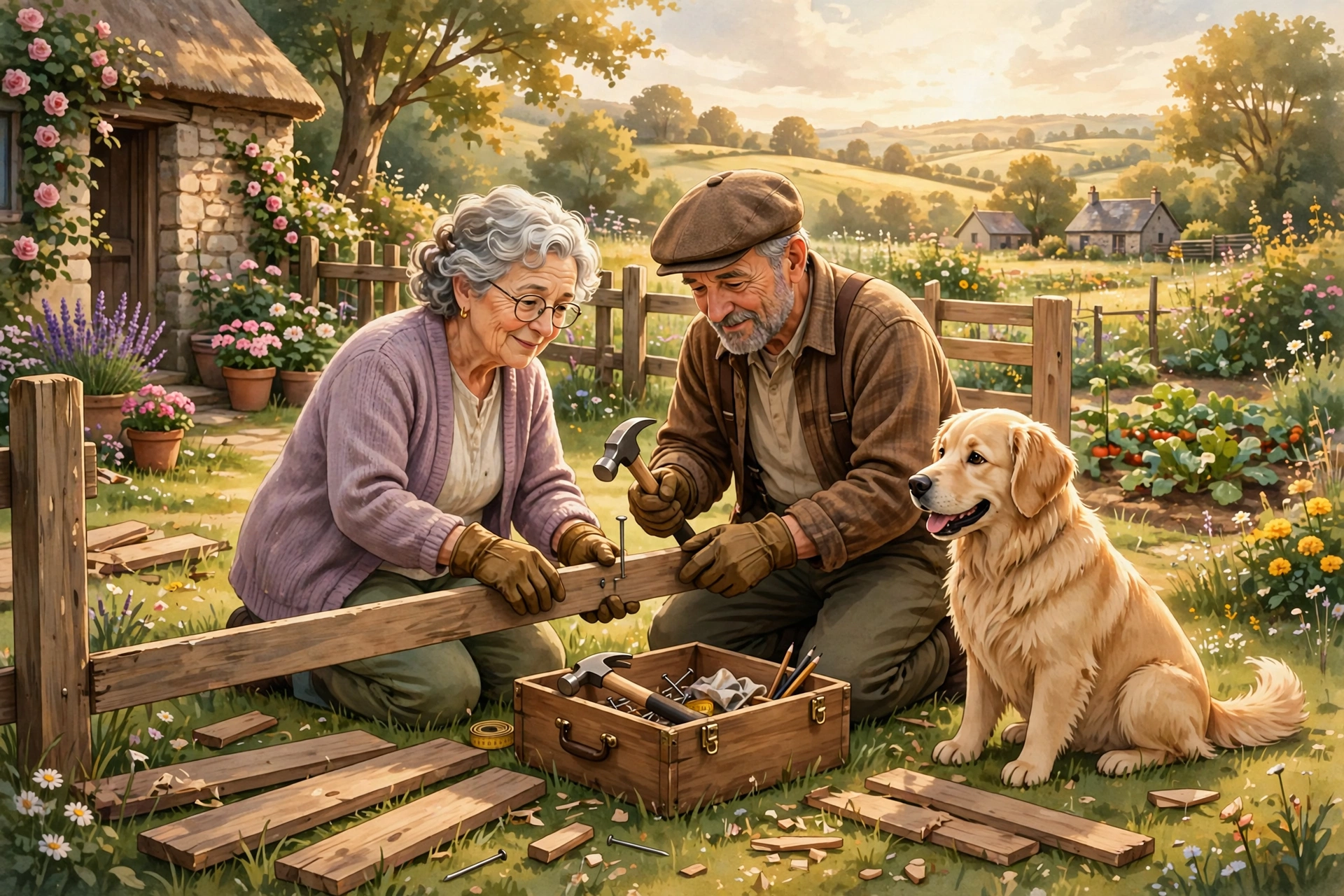
Daniel was in the gap, on his knees, fitting new planks into the fence. Beside him lay his toolbox, and a letter of his own, half-written on top of it: I am sorry too. I should have apologised eleven years ago.
Ruth stood at her window for a long moment. Then she picked up her own hammer, walked out into the garden, and knelt beside him. They did not say much at first. They measured, sawed, and nailed, working side by side the way neighbours do. Daniel’s dog watched from the grass, tail thumping. When the last plank was in place, Daniel wiped his hands and said, “I kept your lettuces’ revenge in my head for eleven years. It was a heavy thing to carry.”
“Mine was heavier,” Ruth said, and then laughed — a real laugh, the first one that had crossed that fence in over a decade. “I think I was angrier at myself for not apologising than I ever was at your goat.”
That afternoon, Sam played with Daniel’s dog in a garden that was no longer divided, and Ruth and Daniel drank tea on her porch like people who had never stopped being neighbours. The fence stood whole between their gardens — not as a wall, but as something they had built together.
Forgiveness, Ruth learned, is not pretending the hurt never happened. It is deciding that the hurt will not be the last word. Like letting go of a stone you have carried too long, it lightens you the moment you set it down — and it opens a door you thought was closed for good.
The Moral of the Story
Forgiveness is not about forgetting what happened or pretending it did not hurt. It is a choice to stop carrying the weight of an old grudge — a choice that frees you first, and often frees the other person too. Peace is worth more than being right, and it is never too late to be neighbours again.
Think About It
- Is there an old quarrel in your life that has lasted longer than the original hurt? What keeps it going?
- What would a first step toward forgiveness look like for you — a letter, a conversation, a simple apology?
- How has holding on to a grudge weighed on you, and what might change if you set it down?
Frequently Asked Questions
What is the moral of “The Mended Fence”?
The moral is that forgiveness frees the forgiver first. Ruth’s apology does not erase the past, but it ends eleven years of quiet bitterness and restores a friendship — proving that it is never too late to make peace.
Why are stories about forgiveness important for adults?
Adults carry real, long-standing hurts — family rifts, broken friendships, workplace wrongs. Stories about forgiveness give us a safe way to imagine the first step, and remind us that second chances can begin with a single honest sentence.
Does forgiving someone mean the hurt did not matter?
No. Forgiveness does not minimise the hurt or excuse what happened. It means refusing to let that hurt define the future — choosing peace over punishment, for your own sake as much as anyone else’s.