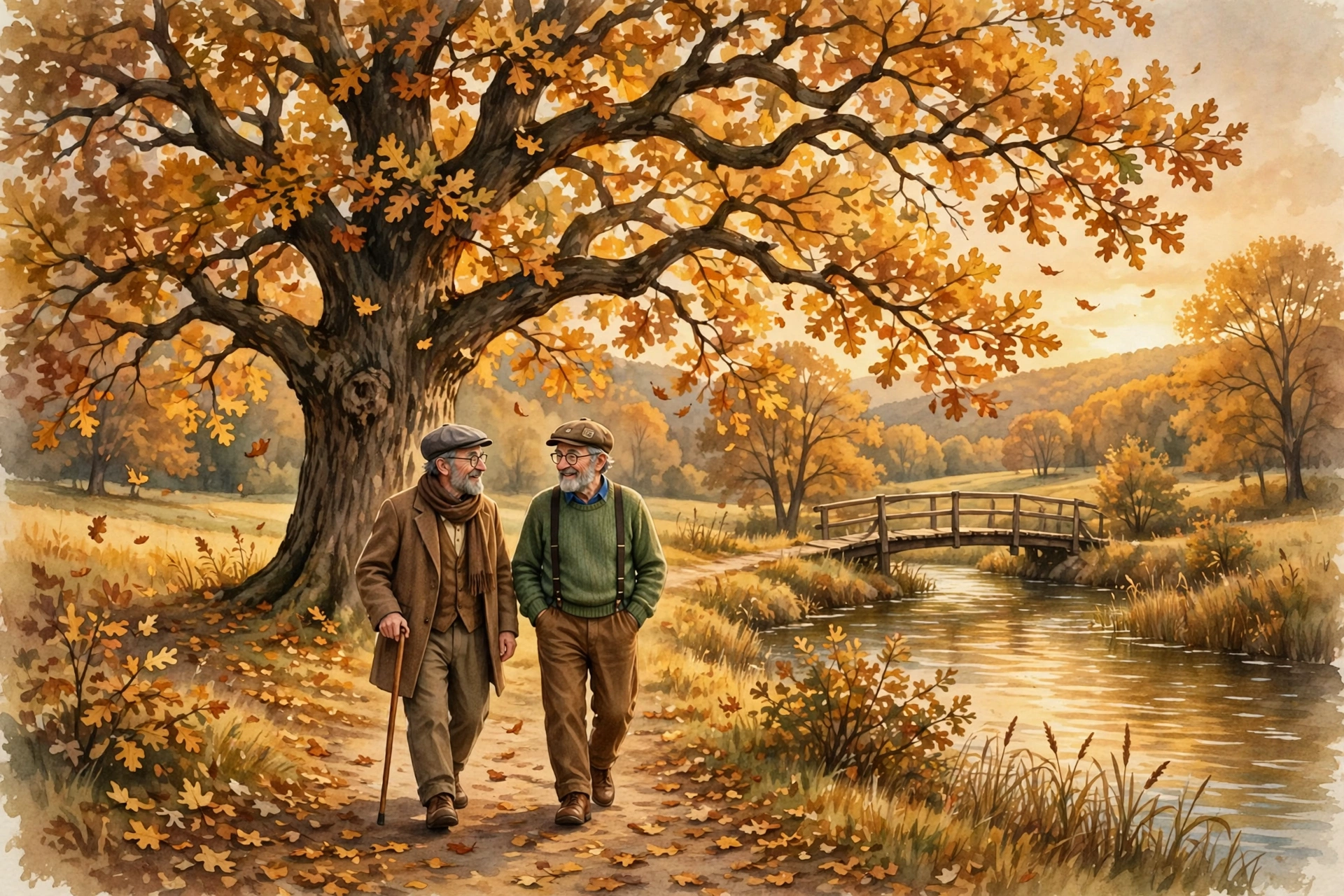
Every great story about a friendship has the same quiet truth at its heart: real friends do not measure the distance between them — they keep the promise. This is one of those stories: two boys, one old oak tree by the river, and a promise that waited forty years to be kept.
The Long Way Home
Daniel and Sam were nine years old the first time they took the long way home.
The short way from school ran straight down Mill Street, past the bakery and the bus stop, and took eleven minutes. The long way followed the river — past the old oak tree, over the wooden footbridge, and along the towpath where the kingfishers nested — and took nearly an hour.
Every day, without ever discussing it, the two boys chose the river.
They skipped stones and argued about whose stone skipped furthest. They built dams out of twigs and watched the water find a way around them. They talked about everything that mattered to a nine-year-old: the best hiding places, the teacher they hoped they would never get, and what they would be when they grew up. Daniel wanted to be a lighthouse keeper. Sam wanted to be an explorer, the kind who found places no one had ever seen.
One October afternoon, under the old oak tree, Sam carved two small marks into the bark — a D and an S, side by side.
“If we ever get lost,” Sam said, very seriously, the way only a nine-year-old can be, “we meet here. No matter what. Even if it’s forty years from now.”
“Promise?” Daniel asked.
“Promise,” Sam said, and they shook on it with muddy hands.
Five years later, Sam’s father got work in a city three hundred miles away, and the family moved in the middle of the school term. There was no goodbye party, no long farewell — just a hurried morning, a loaded car, and Sam waving from the back window until the road bent and he was gone.
For a while, they wrote letters. Long, messy letters full of news and drawings and plans to meet again. Then the letters grew shorter. Then they stopped altogether, the way letters do when life gets in the way — new schools, new friends, new worries, and the slow, ordinary forgetting of childhood.
Daniel stayed in the town by the river. He became a teacher at the very school he and Sam had walked home from, and every autumn he walked his own pupils past the old oak tree, though he never told them about the two small marks carved into its bark.
Forty years passed.
Then one October afternoon — the kind of golden afternoon that smells of woodsmoke and fallen leaves — Daniel took the long way home, the way he still did when he needed to think. The river was low, the kingfishers were gone, but the old oak still stood, broad and patient, where it had always stood.
And sitting beneath it, on the roots, was an old man with grey hair and a walking stick — looking up at two small marks carved into the bark.
Daniel stopped. His heart beat so hard he was sure the whole river could hear it.
“Sam?” he whispered.
The old man turned, and for a moment neither of them spoke. Then Sam laughed — the same laugh, older now, but unmistakable — and held out a hand.
“You took the long way home,” Sam said.
“So did you,” Daniel said, and they shook hands the way they had as boys — firmly, like it meant something.
They sat under the oak until the light went amber over the river, talking the way old friends do: not catching up on everything, but picking up exactly where they left off, as if the forty years had been nothing more than a long walk between two sentences.
Sam had retired. His wife had passed two winters before. He had come back to the town by the river because, he said, there was one promise he had never kept, and he was too old to leave promises unkept.
“I remembered the tree,” Sam said quietly. “I just didn’t know if you’d remember too.”
Daniel looked at the two small marks in the bark — a D and an S, side by side, grown wider with the years but still there.
“Some things,” he said, “you don’t forget. You just wait.”
From that day on, the two old friends took the long way home together again — slower now, with walking sticks and more pauses to catch their breath, but together. And the townsfolk, watching them go by, said it was the finest sight in the whole town: two men who had kept a promise for forty years, and never once thought of breaking it.
Because that is what friendship is. Not the years you spend side by side — but the promise you keep, even when the whole world has come between you.
The Moral of the Story
True friendship is not measured by how often you meet, but by how faithfully you keep your word. Distance, time, and silence can separate friends for years — but like two friends who sat on the same bench through every season of life, a real friendship waits patiently under its old oak tree, ready to pick up exactly where it left off. Keep your promises. The friends worth keeping are the ones who will still be there, forty years later, when you come home.
Think About It
- Who is the friend you made a promise to long ago — and have you kept it?
- Is there an old friendship that distance or silence has paused, but not ended?
- What small promise could you keep today that your friend would still remember forty years from now?
Frequently Asked Questions
What makes “The Long Way Home” a touching story about a friendship?
It is a touching story about a friendship because it shows two boys who promise to meet under an old oak tree if they ever get lost — and forty years later, after a move, silence, and a whole lifetime apart, Sam returns to that same tree and finds Daniel waiting, proving that a real friendship can outlast distance and time.
Why do stories about friendship matter?
Stories about friendship matter because they remind us that the people who shape our lives are often the ones who walked beside us when we were young — and that loyalty, not constant contact, is what keeps a friendship alive through the years.
What is the moral of “The Long Way Home”?
The moral is that true friendship is measured by kept promises, not by how often you meet. Distance and time can pause a friendship, but they cannot end one that was built on a promise both friends meant.