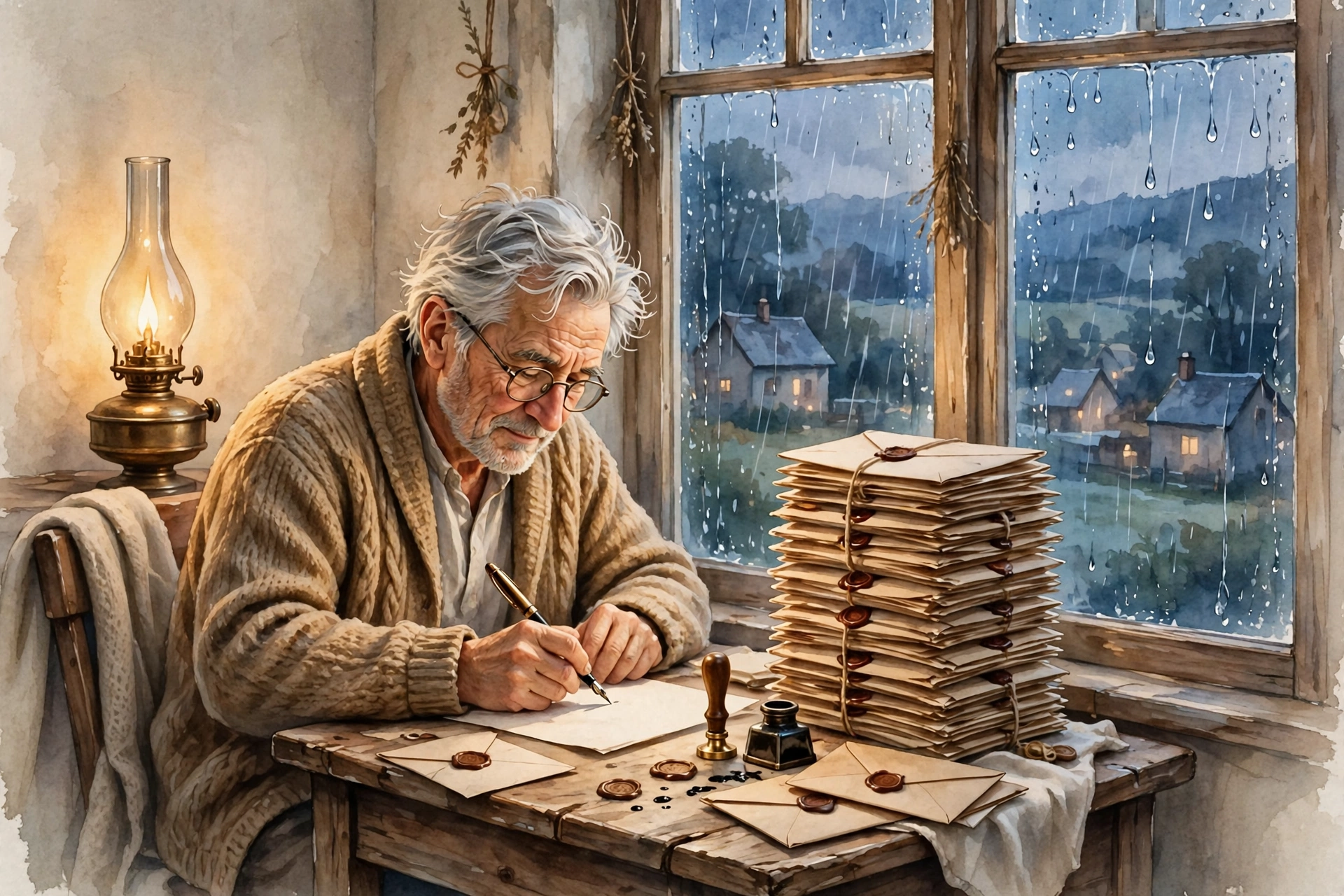
Some memorable love stories are not about grand gestures or dramatic reunions. They are about quiet devotion — the kind that shows up every single year, without applause, without witnesses, without ever asking for anything back. The Letter He Never Sent is one of those stories, and it begins, as the best love stories often do, with a promise made in the rain.
The Letter He Never Sent
Every year on the first of October, Thomas Alden sat down at the small wooden desk by his window and wrote a letter he would never send.
He had started in 1986. He was twenty-four then, standing on a rain-slicked platform in a town he had only meant to pass through, with a train ticket in his pocket and his heart wide open. Her name was Clara, and she had missed her train — or so she had claimed — and they had talked for three hours under the station awning while the rain hammered down.
They had exchanged addresses. He had promised to write. And he did write — that very night, a long letter full of the things he had been too shy to say aloud. But the next morning, fear got the better of him. What if she had only been passing the time? He folded it, put it in a drawer, and told himself he would send it tomorrow. Tomorrow became next week, next week a new job in another city, and the letter stayed in the drawer.
On the first of October the following year, he wrote a second letter. Then a third. Each one a little braver than the last, each one telling Clara — wherever she was — about the year he had lived: the promotion he had not wanted, the dog he had adopted, the apartment with the leaky roof and the good light.
He never sent a single one. Not because he forgot, but because the letters had become something else: proof that love does not always need an audience to be real. Some loves are like two strangers sharing one umbrella on a rainy platform — brief, unplanned, and somehow unforgettable. Thomas kept writing anyway, the way some people keep a garden: not for the harvest, but for the tending.
Forty years passed. Thomas retired, his hair turned white, and the drawer held forty letters.
Then, one autumn morning, his granddaughter Maya came to visit and found him staring at the drawer.
“Grandad, what are those?” she asked.
Thomas hesitated. For forty years, the letters had been a private secret, like a prayer. But Maya had kind eyes, and she was twenty-four, the age he had been when he met Clara.
“Letters to someone I loved once,” he said. “I never sent them. I was afraid.”
Maya picked up the first envelope and looked at him with the fierce tenderness only the young possess. “Grandad,” she said, “it’s never too late to begin again. You taught me that. Second chances don’t expire — they just wait for us to be brave enough to take them.”
That afternoon, Maya did something Thomas had never dared to do. She took the newest letter — the fortieth — put a stamp on it, and walked it to the postbox herself. The address was forty years old. The odds were laughable. Thomas watched her from the window and felt something loosen in his chest, like a knot finally coming undone.
Three weeks later, a reply came.
It was written in a careful, looping hand on pale blue paper. Clara — now a widow, living two towns away — had kept his address too, all these years, tucked inside her favourite book. She had thought of him every October, she wrote, wondering whether the young man from the platform ever thought of her.
Thomas read the letter three times, then folded it gently and placed it on top of the other forty. The next morning, he put on his best coat, bought yellow flowers — her favourite, mentioned once, forty years ago — and took the train to her town.
She was waiting at the station. Her hair was silver now, and she was smiling the exact same smile. “You came,” she said.
“I should have come forty years ago,” Thomas said.
Clara took his hand. “You’re here now,” she said. “That’s what matters. Some stories take forty years to reach their ending — and that doesn’t make them late. It makes them memorable.”
They walked out of the station together, slowly, like people with all the time in the world. Behind them, the rain began to fall — soft, steady, and right on time.
The Moral of the Story
Love is not measured by how quickly it arrives, but by how faithfully it is kept. A feeling tended quietly for forty years is no less real than one shouted from the rooftops — and it is never too late to be brave with your heart. The most memorable love stories are the ones that refuse to give up, even when the ending seems impossible.
Think About It
- Is there something — or someone — you have been afraid to reach out to? What is the smallest brave step you could take today?
- How does Thomas’s forty-year devotion change the way you think about patience in love?
- What does Clara’s reply teach us about the love we think we have lost forever?
Frequently Asked Questions
What makes a love story memorable?
A memorable love story pairs genuine emotion with an ending that feels earned. It is not the grand gesture that stays with us, but the quiet devotion — showing up, year after year, even when no one is watching.
Is it ever too late to reconnect with a lost love?
As Thomas and Clara’s story shows, it is rarely too late. People change, lives move on, but a sincere, honest reaching-out can open doors we assumed were closed forever — the worst that can happen is a kind no, and the best can change everything.
Why do short love stories stay with us?
Short love stories distil a lifetime of feeling into a few pages. By focusing on one choice, one letter, one rainy afternoon, they let us feel the whole weight of a love without needing a whole novel to carry it.