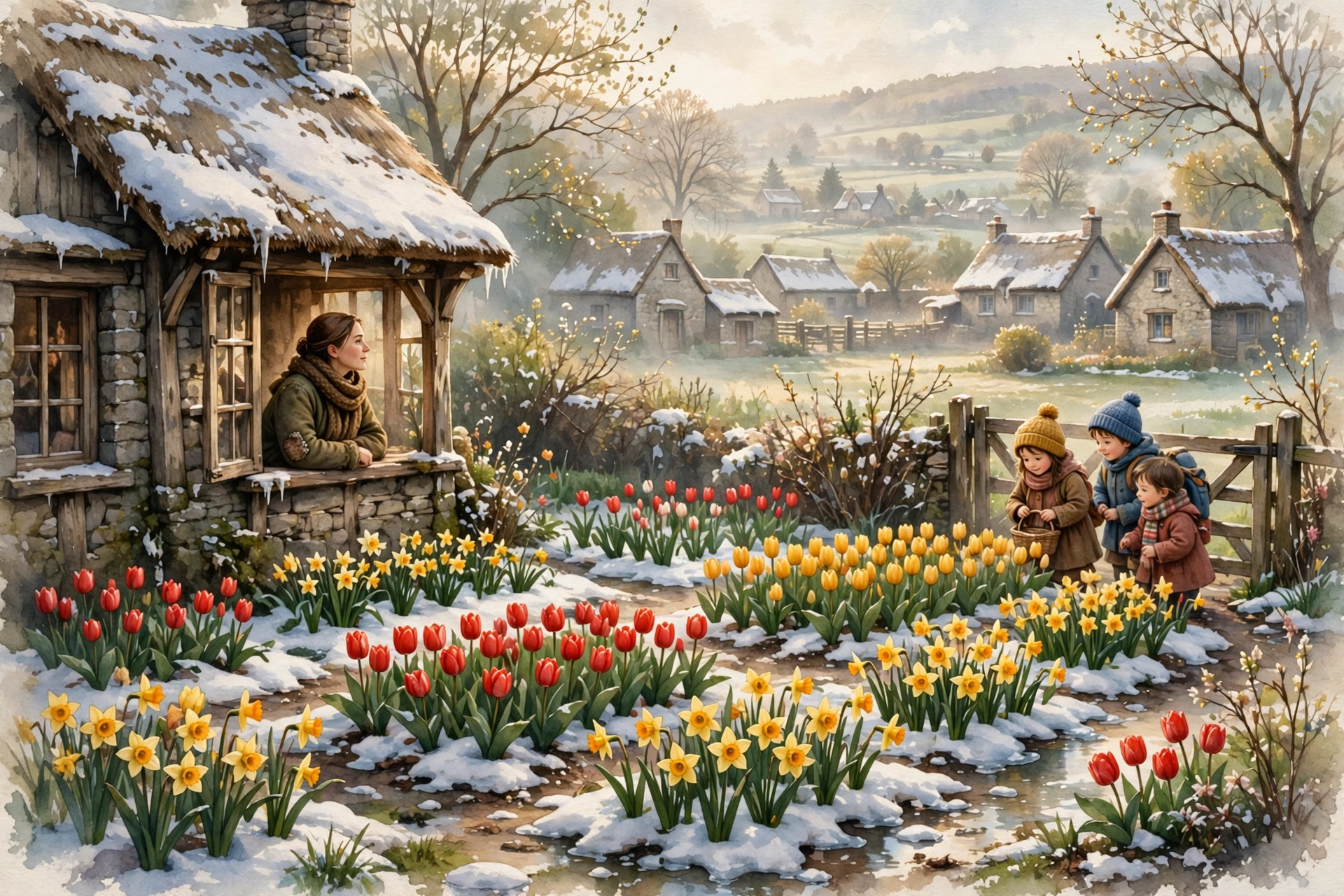
The best stories on hope are rarely about grand rescues or sudden miracles. They are about ordinary people who refuse to stop believing that something good is still coming. This is one of them — the story of a woman who planted a garden in the middle of winter, when everyone around her said nothing would ever grow again.
The Garden That Waited
When the factory closed, the town of Aldermere closed with it. The gates were chained, the shifts ended, and within a year half the houses on Mill Lane stood empty, their gardens gone to weeds. Mara Ellison lost her job, her husband, and — for a while — her belief that anything in her life would ever get better.
That November, on the coldest morning of the year, Mara did something her neighbours thought was madness. She went out into her bare back garden with a spade, a paper bag of bulbs, and a pair of gloves with a hole in one thumb — and she started to dig.
“Mara,” called old Mr. Fenwick over the fence, “the ground’s frozen solid. Nothing grows in November.”
“I know,” Mara said, and kept digging.
By evening she had planted two hundred bulbs — tulips, daffodils, crocuses — in neat rows across the frozen earth. Then she went inside, made tea, and said nothing more about it.
Winter settled over Aldermere like a held breath. Snow came, then more snow. The pipes froze. The bus stopped running. Mara’s savings ran low, and some nights she sat by the window and wondered whether Mr. Fenwick had been right — whether she had buried her last bit of hope in cold, dark ground for nothing.
But every morning, she still went to the window and looked at the garden. Nothing to see. Just snow. She looked anyway.
In February, a girl from two doors down knocked on Mara’s door. Her name was June, she was nine years old, and her family had just moved into one of the empty houses on Mill Lane.
“My mum says you planted flowers in the snow,” June said. “Is that true?”
“I planted bulbs,” Mara said. “They sleep underground all winter. Then, when it’s time, they wake up.”
“How do you know they’ll wake up?” June asked.
Mara thought about that. “I don’t,” she said honestly. “But I planted them anyway. That’s what hope is — planting something before you can see it grow.”
June came back the next day. And the next. She brought a friend, then another. Soon a small band of children gathered at Mara’s window each morning to check the garden, pressing their noses to the glass, arguing over which patch of snow would bloom first.
Then one March morning, Mara opened her curtains and stopped. A green tip, no taller than a fingernail, had pushed through the soil. Then another. Then a dozen. By the end of the week, the whole garden was pricked with green shoots, standing up in the cold air like a crowd that had decided, all at once, to arrive.
When the first crocus opened — a small purple cup, brave against the grey sky — the children cheered so loudly that Mr. Fenwick came out to see what the fuss was about. He stood at the fence for a long time, looking at the flowers, and then he said, quietly, “Well. I’ll be.”
By April, Mara’s garden was the brightest thing in Aldermere. Tulips in red and gold. Daffodils nodding in the wind. And people began to stop at the gate — first the children, then their parents, then strangers from streets Mara had never walked. They didn’t come just to look at the flowers. They came to stand in a place where something had grown when nothing was supposed to.
That summer, three more gardens on Mill Lane were dug and planted. A year later, the old factory building reopened as a workshop, and the first thing its new owners did was ask Mara to plant the flower beds out front.
Mara still plants bulbs every November. She does it on the coldest morning of the year, in gloves with a hole in one thumb, and the children of Mill Lane still gather at her window to watch. They know now what she knew all along: that hope is not the belief that the winter will skip you. It is the decision to plant anyway — because spring has never once forgotten to come.
The Moral of the Story
Hope is not a feeling that arrives when things get better; it is a choice you make while things are still hard. Mara planted her garden in frozen ground with no guarantee it would bloom — and that act of planting, done in the dark of winter, is what gave everyone around her something to look forward to. Like a pianist who keeps playing through the night, hope keeps going until the morning comes. Plant something. Then wait, and watch.
Think About It
- What is one “bulb” you could plant in your own life right now — something small, done in faith, before you can see the result?
- When has someone else’s hope — a neighbour, a friend, a stranger — helped you through your own winter?
- How would your hardest season feel different if you treated it as a waiting time, not an ending?
Frequently Asked Questions
What is the moral of “The Garden That Waited”?
The moral is that hope is an action, not just a feeling. Mara planted bulbs in frozen ground with no proof they would bloom — and her quiet act of hope inspired a whole street to believe again. Spring always comes, but someone has to plant first.
Why do stories on hope matter?
Stories on hope matter because they remind us that dark seasons are not permanent. They show ordinary people choosing to act — to plant, to practise, to keep going — before the outcome is visible, and that is exactly the kind of courage the rest of us need to borrow when our own winter arrives.
Can hope really change anything?
Yes. Hope changed everything in Aldermere: one garden became three, three became a street, and a street became a town that believed in itself again. Hope does not remove the winter — but it decides what you do during it, and what you do during it decides what blooms in spring.