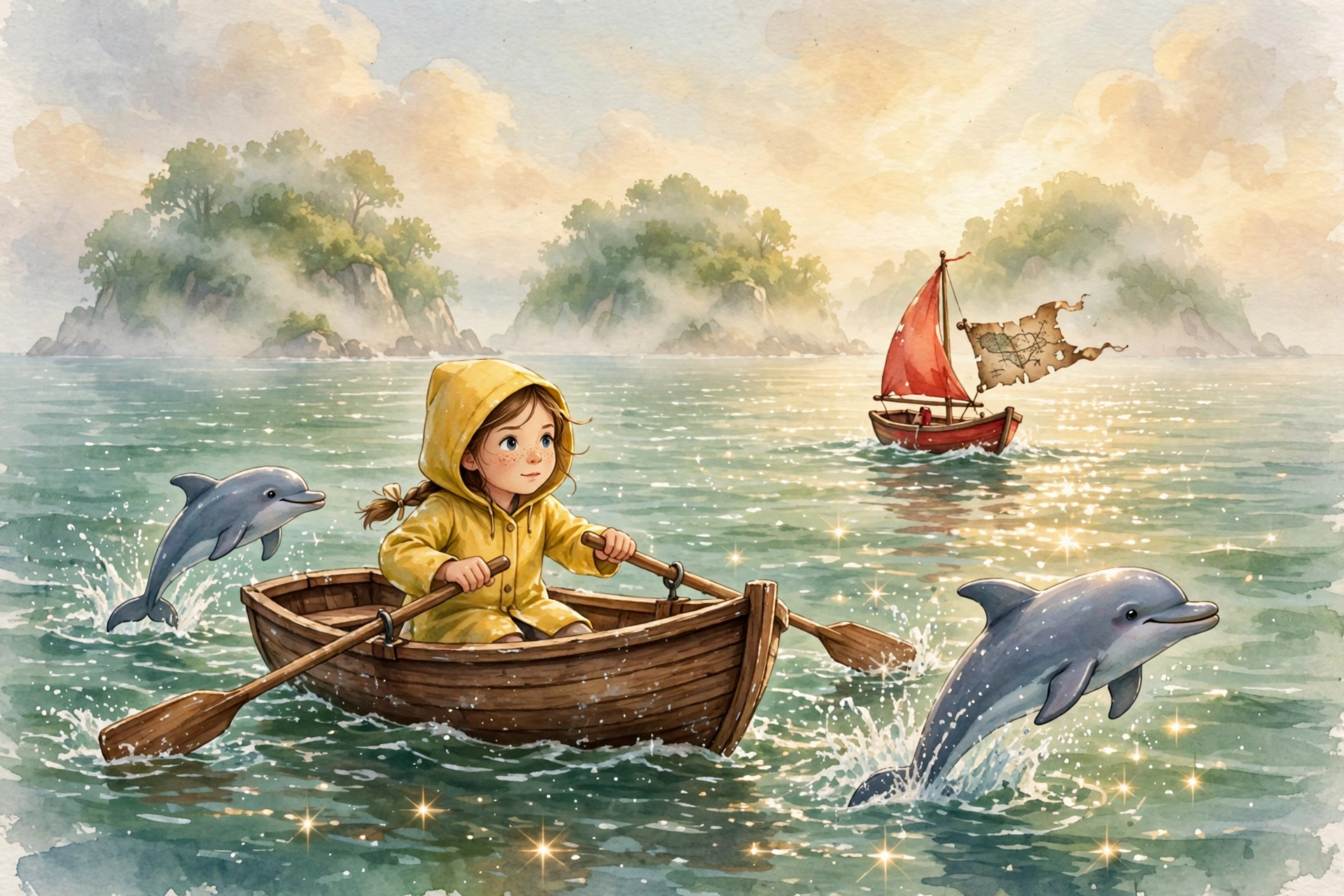
The best adventurous short stories for childrens begin with an ordinary day and one small surprise that changes everything. This is one of them — the story of a girl named Wren, a map that refused to stay put, and a race across the sea to bring it home.
The Map That Sailed Away
Wren lived in a lighthouse town, where the houses were painted like sweets and every garden gate opened onto the sea. Her grandmother kept a shop full of maps — maps of islands nobody had visited, maps of rivers that changed their minds, maps with a small red X where the treasure was supposed to be.
“Maps are promises,” her grandmother always said. “They promise that somewhere out there is worth going to.”
One wild October morning, a storm blew in off the water, rattled the shop’s shutters, and snatched the oldest map in the shop — the Map of the Wandering Isles — right off its hook and out through the open door. Wren watched it tumble across the cobbles, flap over the harbour wall, and land, fluttering, on the deck of a little red sailboat that was pulling away from the pier.
“That map is the only copy in the world!” her grandmother cried. “If it reaches the Wandering Isles without us, the islands will move, and no one will ever find them again!”
Wren did not stop to think. She grabbed her grandmother’s yellow raincoat, her pocket compass, and a biscuit for the road — and she ran for the last boat in the harbour: a wobbly little rowing boat called the Pebble.
“You can’t row after a sailboat!” shouted old Captain Bram from the pier.
“Watch me,” said Wren, and pushed off.
The sea was not kind. The waves slapped the sides of the Pebble and the wind tried to steal her hat, but Wren rowed the way her grandmother had taught her — steady, steady, one stroke at a time — until the red sailboat came into view again, bobbing ahead like a bright fish.
Then the trouble began. A pod of dolphins surfaced beside her, chattering and splashing, and one of them nudged the Pebble so hard that Wren’s biscuit flew into the sea. The dolphins laughed — at least, it sounded like laughing — and swam in a circle around her, herding her gently toward a narrow gap between two rocks that she had never noticed before.
“Are you helping me?” Wren asked.
The smallest dolphin leapt clean out of the water and splashed her, which Wren decided meant yes.
Beyond the rocks, the sea went suddenly calm and strange. The water turned the colour of green glass, and ahead of her, rising out of the mist, were the Wandering Isles — three islands that drifted slowly, like boats that had forgotten to drop anchor. And there, tied to a jetty on the middle island, was the little red sailboat, with the map still fluttering on its deck.
Wren tied up the Pebble, crept aboard the sailboat, and reached for the map — and froze. Sitting on the map, guarding it like a guard dog, was a crab the size of a dinner plate, with one enormous claw and a very unimpressed expression.
“Please,” said Wren, “that map belongs to my grandmother’s shop. Without it, the islands will wander off and no one will find them.”
The crab waved its big claw. Then it pointed — with the small claw — at a loose board on the deck, where a tiny silver key was wedged.
Wren understood. The crab wasn’t guarding the map. It was guarding the key, and the key opened the little chest under the sailboat’s seat — a chest full of shiny bottle tops, which was, to a crab, the greatest treasure in the world.
“A trade, then,” said Wren. She pulled the shiny brass button off her grandmother’s raincoat — the one shaped like a star — and held it out. “For the key.”
The crab studied the button. It glittered. It was a star. The crab snatched it, handed over the key with the small claw, and scuttled away to admire its new treasure.
Wren unlocked the chest, filled her pockets with bottle tops for the crab’s friends, folded the map carefully into her raincoat, and rowed home with the dolphins escorting her all the way — leaping and splashing, as if the whole sea were cheering.
When she reached the harbour, her grandmother was waiting on the pier, and the whole town had come out to see. Wren handed over the map, and her grandmother hugged her so hard her hat fell off.
“You did it,” her grandmother whispered. “You kept the promise.”
“Maps are promises,” said Wren, grinning. “And I promised I’d bring it back.”
That night, the map went back on its hook — with a brand-new red X drawn on it, right where the Wandering Isles had been. And underneath, in Wren’s handwriting, were the words: Found by Wren. Kept by the sea. Shared with friends.
She still rows out to the islands sometimes, when the wind is right. The crab waves its big claw at her. The dolphins race her home. And every map in the shop now carries the same small note, in the corner, where only brave readers look: Adventure starts the moment you decide to go.
The Moral of the Story
Adventure does not wait for you to feel ready — it arrives on a windy morning and asks you to go anyway. Wren had no sailboat, no crew, and no plan; she had a compass, a raincoat, and the decision to start rowing. Like a man who kept running at dawn, she discovered that courage is not the absence of fear, but the choice to move forward while the waves are still slapping the boat. Start before you feel ready. The sea helps those who row.
Think About It
- When has an ordinary day of yours suddenly turned into an adventure — and what did you do first?
- What is your “pocket compass” — the one small thing that helps you find your way when things get stormy?
- Who would you want beside you on a boat to the Wandering Isles, and what would you trade for the key?
Frequently Asked Questions
What makes a good adventurous short story for children?
A good adventurous short story for children pairs a brave young hero with a clear quest, a few surprising helpers, and a problem that can only be solved by thinking, not fighting. The best ones end with the hero coming home changed — braver, kinder, or wiser than before.
What is the moral of “The Map That Sailed Away”?
The moral is that courage means starting before you feel ready. Wren rowed after a sailboat in a little rowing boat because the map mattered — and along the way she found friends, solved a problem with a fair trade, and kept a promise. Adventure rewards those who begin.
Why do children love adventure stories?
Children love adventure stories because they let young readers practise bravery safely. Through a hero like Wren, a child can face storms, meet strange creatures, and solve impossible problems — and finish the story believing they could do the same.