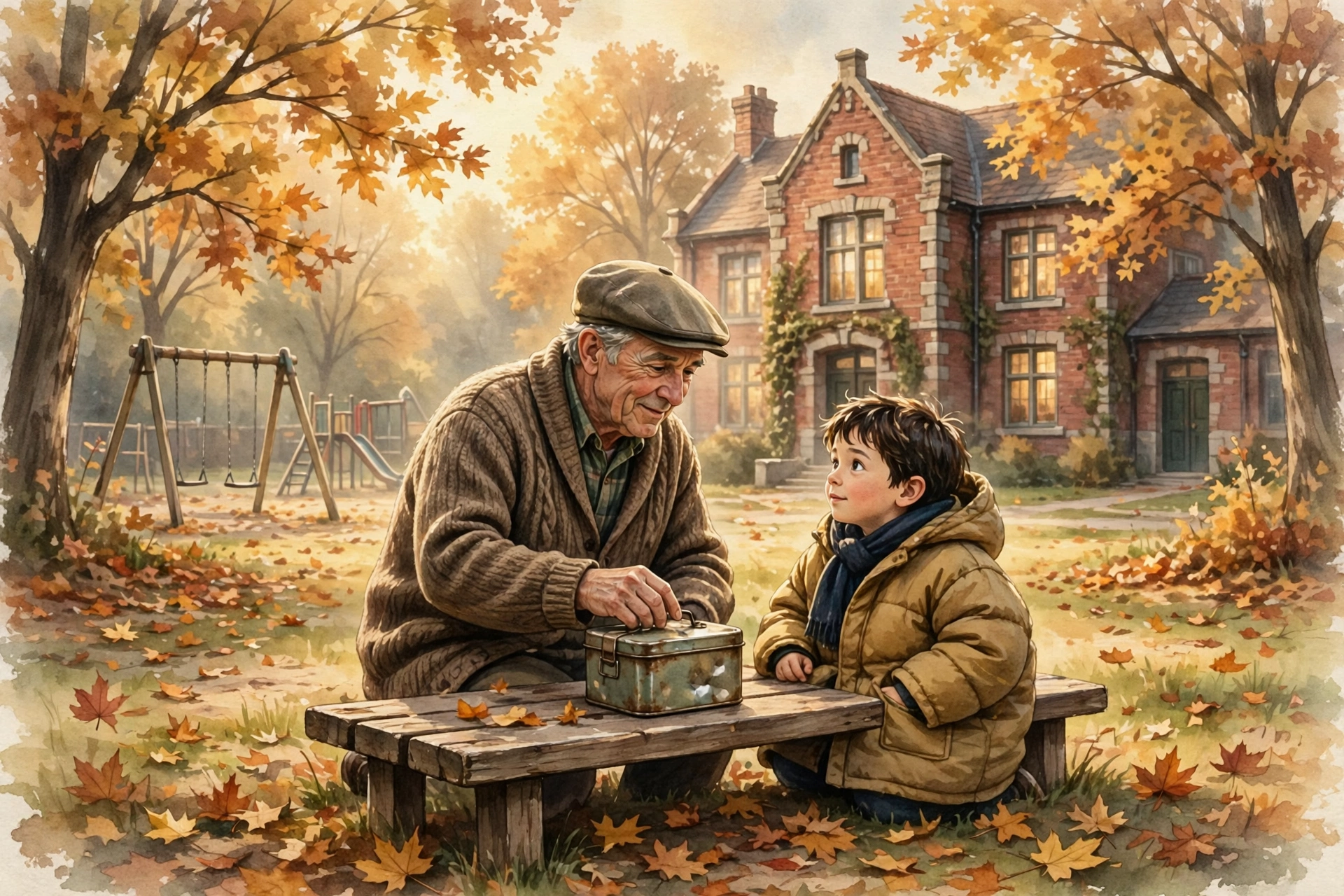
Some of the best stories of kindness are never told out loud — they are simply lived, quietly, by people who expect nothing in return. This is one of them. It is the story of a school caretaker named Arthur Blythe, a hungry boy called Sam, and a dented tin lunchbox that appeared on the same bench every single day.
The Tin Lunchbox
Arthur Blythe had been the caretaker at St. Hilda’s Primary School for thirty-one years. He swept the corridors before the children arrived, fixed the radiators that rattled in winter, and knew every child’s name — even the ones who never spoke to him.
That autumn, he noticed a boy in Year Five who sat alone at the far end of the playground every lunchtime, swinging his legs on a bench and watching the other children eat. The boy’s name was Sam. His coat was two sizes too big, his shoes were held together with tape, and his pockets were always empty.
Arthur watched for a week before he did anything. On Monday, Sam pretended to read a book while the others ate. On Tuesday, he drank water from the fountain and called it lunch. On Wednesday, a girl offered him half her sandwich, and Sam shook his head and said he wasn’t hungry — though his stomach growled loud enough for Arthur to hear it from across the yard.
On Thursday morning, Arthur stopped at the bakery on his way to school and bought two rolls, a slice of cheese, an apple, and a small bar of chocolate. He packed them into a dented tin lunchbox he had found in the lost-property box years ago, and at lunchtime he set it on the bench beside Sam — and walked away without a word.
Sam stared at the lunchbox. He looked around. Nobody was watching. He opened it slowly, as if it might disappear.
He ate every crumb.
The next day, the lunchbox was there again. And the day after that. And the day after that. Arthur never said a word about it. He simply made sure the lunchbox was full each morning and placed on the same bench before the bell rang.
Sam never said a word about it either. But something in him began to change. He started raising his hand in class. He started kicking a football with the other boys. He started smiling — a real smile, the kind that reaches the eyes.
One cold December afternoon, the headteacher called Arthur into her office.
“Arthur,” she said gently, “I’ve had a letter. Sam’s mother lost her job in the summer. She’s been skipping her own meals so Sam can eat at home in the evenings. She wanted me to know that someone at this school has been feeding her son at lunchtime — and she wanted to say thank you. She doesn’t know who it is.”
Arthur looked at his hands. “Then she’d better not find out,” he said. “It was only a lunchbox.”
“It was never only a lunchbox,” the headteacher said.
That Christmas, Sam’s mother found a job. Things got better — slowly, the way good things usually do. Sam grew taller, his shoes were replaced, and by spring he had stopped sitting alone on the bench. He had friends now, and a packed lunch of his own.
But the tin lunchbox never went back to the lost-property box. Arthur kept it on the shelf in his little caretaker’s room, dented and scratched, beside his kettle and his radio.
Years later, Sam returned to St. Hilda’s as a young man — a teacher now, with a classroom of his own. On his first day, he walked into Arthur’s room and set a brand-new lunchbox on the shelf beside the old tin one.
“For the next one,” Sam said. “There will always be a next one.”
Arthur looked at the two lunchboxes sitting side by side, and he smiled — because kindness, once it is given, does not end with the person who receives it. It passes on, like an open gate that never quite closes, inviting the next person through.
The Moral of the Story
Kindness does not need an audience, a reward, or even a thank-you. Arthur never told anyone about the lunchbox, and he never needed to — the kindness did its work quietly, and then it multiplied. The smallest gift, given steadily and without fanfare, can change the course of a life, and the life it changes will go on to change another.
Think About It
- Who in your life might be quietly going without something — and how could you help without making a show of it?
- What is one small, steady kindness you could offer every day, the way Arthur filled the lunchbox?
- Has a kindness someone showed you ever inspired you to pass it on? What did you do?
Frequently Asked Questions
What is the moral of “The Tin Lunchbox”?
The moral is that quiet, consistent kindness changes lives. Arthur’s daily lunchbox gave Sam far more than food — it gave him dignity, confidence, and the belief that someone cared. And Sam carried that kindness forward, just as kindness always does.
Why do stories of kindness matter?
Stories of kindness remind us that goodness is often quiet and ordinary — a lunchbox, an open gate, a few minutes of someone’s time. They show us that we do not need wealth or power to matter; we only need to notice the people around us and act.
Can one small act of kindness really change a life?
Yes — and this story shows how. A single lunchbox gave a hungry boy the strength to learn, to make friends, and to believe in himself. Years later, that boy became a teacher who keeps the chain of kindness going. One small act, repeated daily, becomes a legacy.