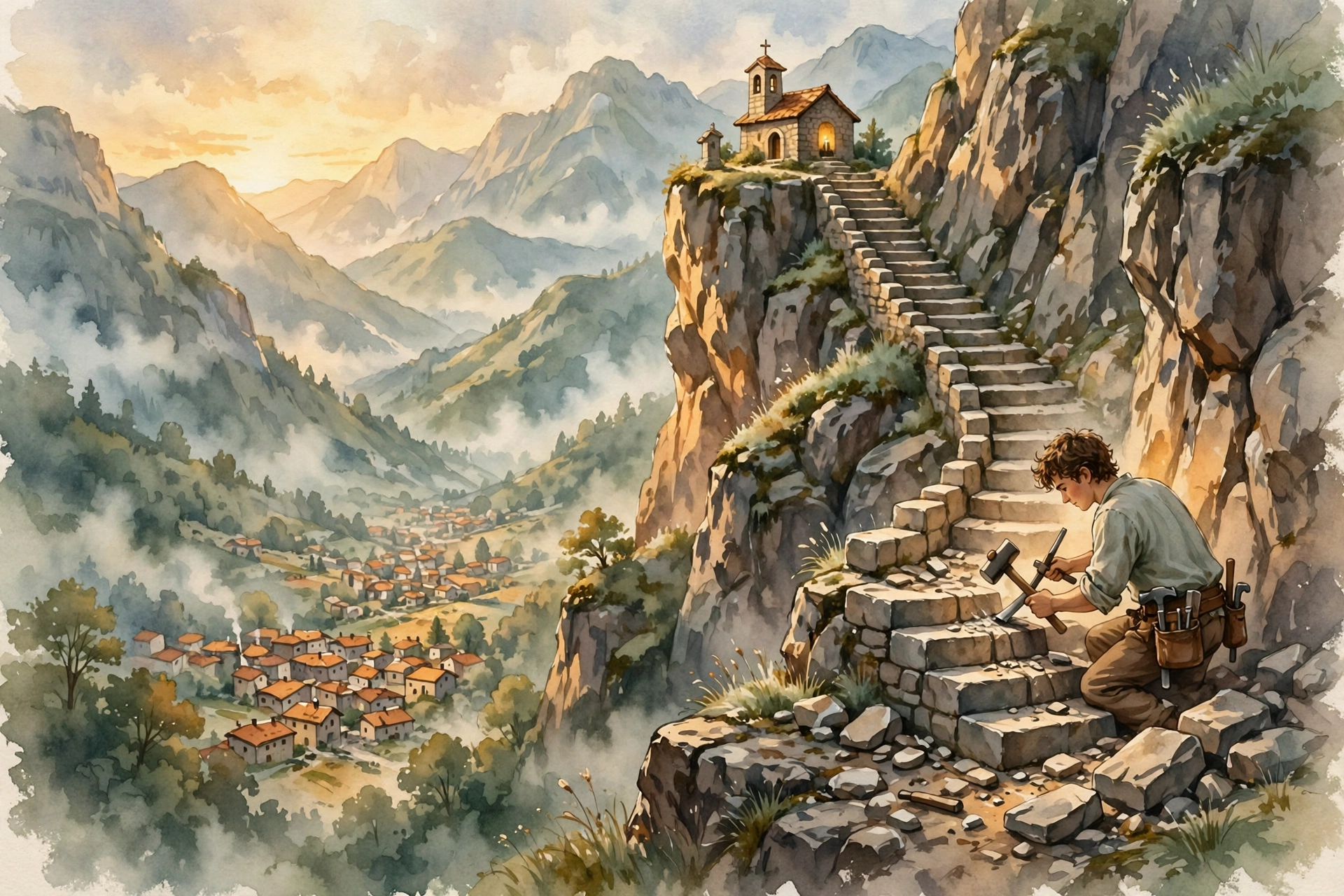
A short story about determination is a story about someone who refuses to stop — not because the work is easy, but because the goal matters more than the difficulty. This is the story of Tomas, a young stonemason who carved a staircase up a mountain, one step at a time, when everyone told him it could not be done.
The Stone Staircase
In the mountain village of Aldermere, the chapel stood on a ledge high above the houses, and the only way up was a steep goat track that turned to mud in the rain and ice in the winter. For generations, the villagers had talked about cutting stone steps into the cliff, and for generations, they had agreed it was too much work for too little reward.
Tomas was seventeen when his grandfather, the village stonemason, died. On his workbench, beneath a cloth, Tomas found a drawing: a staircase of one hundred and twenty steps, curving up the cliff face to the chapel door, every step measured and numbered in his grandfather’s careful hand. At the bottom of the page, in faded ink, were four words: “One step at a time.”
Tomas took the drawing to the village council. The elders looked at it, looked at the cliff, and shook their heads. “A hundred and twenty steps, cut by hand?” said Master Bren. “It would take a year, boy. And you are one pair of hands.” “Then it will take a year,” said Tomas. “And I am one pair of hands.”
He began the next morning, before sunrise, with his grandfather’s hammer and chisel. The first step took him three days. The rock was harder than he had expected, and his arms ached so badly that first night that he could barely lift his supper spoon. He lay awake and wondered whether Master Bren had been right.
But in the morning, he went back to the cliff. He learned to read the stone the way his grandfather had taught him — to strike along the grain, never against it, and to let the rock do half the work. The second step took two days. The third took one. By the end of the first month, ten steps climbed the cliff face, rough and true.
The winter came, and with it the hardest months. His hands cracked in the cold. Twice the chisel slipped and cut his knuckles open. Once, a whole step split wrong and he had to start it again from the beginning. Villagers passing on the goat track would call up to him, “Still at it, Tomas?” and he would answer, “Still at it.” He never said more than that.
In the spring, something changed. A boy named Pip began to carry Tomas’s water up the cliff each morning. Then Old Mara brought him bread at noon. Then two more villagers came with hammers of their own, and asked where they should start. Tomas showed them the drawing, and pointed to the next step. “One step at a time,” he said. “That is the whole of it.”
On the first morning of autumn, exactly one year after he had begun, Tomas set the last stone into the last step. One hundred and twenty steps, each one cut by hand, climbed from the village to the chapel door. He stood at the bottom and looked up at them, and for a long moment, he said nothing at all.
That Sunday, the whole village climbed the staircase together for the first time. The old people who had not reached the chapel in years walked up slowly, holding the new stone rail, and the children ran ahead, counting the steps out loud. Master Bren climbed last, and at the top, he put his hand on Tomas’s shoulder. “A year,” he said quietly. “One pair of hands.”
Tomas smiled. “That is what determination is,” he said. “Not a single great effort, but a small one, repeated every morning, until the mountain moves.” And above the village, the staircase stands to this day — one hundred and twenty steps, each one proof that a person who refuses to stop can climb anything.
The Moral of the Story
This short story about determination is not about a single heroic effort — it is about the small effort, repeated every morning, that adds up to a mountain climbed. Tomas had one pair of hands and one year, and the whole village told him it could not be done. Like an old fisherman who rebuilt his broken boat plank by plank, he discovered that determination is not a feeling you wait for — it is a decision you make before sunrise, one step at a time. The staircase stands because he refused to stop.
Think About It
- What is one thing you have been putting off because it feels too big — and what would its “first step” look like?
- Who told you something could not be done — and were they right, or just counting your hands?
- What small effort could you repeat every morning for a year, and where would it take you?
Frequently Asked Questions
What is determination?
Determination is the decision to keep going toward a goal even when the work is slow, hard, or lonely. It is not about feeling brave or certain. Like Tomas carving his staircase, it means doing one small piece of the work each day, and trusting that the small pieces will add up to something no single effort could build.
What is the moral of “The Stone Staircase”?
The moral is that big goals are finished one small step at a time. Tomas did not carve a staircase in a day — he carved one step, then another, for a whole year. Determination is not a single great effort but a small one repeated every morning, until even a mountain gives way.
Why is determination important?
Determination matters because worthwhile things are rarely quick or easy. Without it, Tomas would have stopped at the first hard rock, and the village would still be climbing a mud track. People who keep going — even slowly, even alone at first — finish what people who wait for the perfect moment never start.
How can I become more determined?
Start with one small step you can repeat every day, and protect it. Write the goal down, tell one person about it, and do the work before the day’s excuses arrive. Determination grows like a muscle — each morning you show up, even when it is cold or hard, makes the next morning easier.