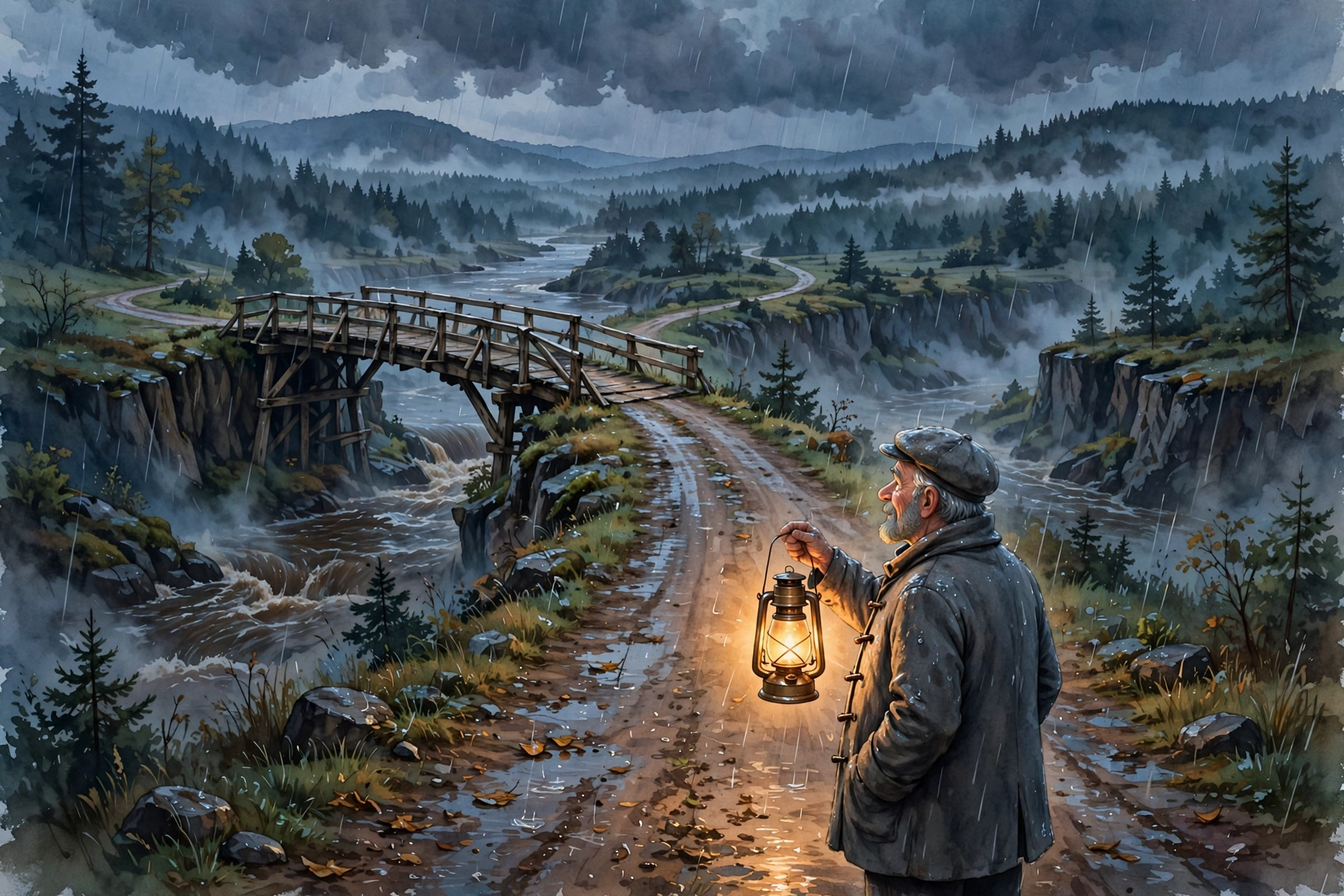
Some of the best stories with heroes are not about capes or crowns, but about ordinary people who refuse to walk away when it matters. The Watchman of Willow Bridge is one such story — about a quiet old watchman, a storm-swollen river, and the night a whole village learned what a hero really looks like.
The Watchman of Willow Bridge
For thirty-one years, Elias had been the watchman of Willow Bridge. The bridge was old — wooden planks over a deep river gorge, held up by iron struts that had rusted in places no one could easily reach. Every evening at six, Elias walked its length with his lantern, tapped each plank with his walking stick, and wrote in his small notebook: “Bridge sound. River low. All well.”
People in the village of Willowford barely noticed him. He was not the mayor, nor the schoolteacher, nor the doctor. He was simply the man in the grey coat who kept the bridge. Children waved to him on their way to school; drivers nodded as they crossed. Nobody thought of him as important — until the night of the great storm.
It came in late October, rain hammering the valley for two days until the river rose brown and furious beneath the bridge, tearing at its supports. On the second evening, Elias made his usual walk — and stopped halfway across. Beneath his boots, one plank gave a soft, wrong groan, and when he held his lantern low, he saw it: a crack running through a main support beam, widening with every shudder of the water below.
Elias did not panic. He walked back to the village side, planted his lantern in the middle of the road, and stood in the rain with his arms outstretched. When the first car approached, headlights cutting through the downpour, he stepped forward and waved it down.
“Bridge is closed tonight,” he said, his voice steady. “Turn back. Go the long way round.”
The driver argued. He was late, the long way added an hour, the bridge had held for decades. Elias did not move. “I have watched this bridge for thirty-one years,” he said. “Tonight, it will not hold. Please — turn back.”
Something in the old man’s calm — that quiet courage that asks for nothing and fears nothing — made the driver turn his car around. Then came another car, and a delivery van, and finally the evening school bus, full of tired children returning from a match in the next town. Elias stopped them all, one by one, explaining patiently, refusing to be hurried or shouted down.
By midnight, the river was roaring. Elias stayed at his post in the rain, lantern burning, coat soaked through, watching the bridge he had loved for half his life. At twenty past one, with a sound like a great sigh, the centre of Willow Bridge sagged, splintered, and fell into the river. The water carried the planks away into the dark.
Not a single person was on it. Not a single person was hurt.
In the morning, the village gathered at the riverbank and stared at the gap where their bridge had been. The mayor shook Elias’s hand and called him a hero. Elias shook his head, embarrassed, and looked down at his muddy boots.
“I only did what the job asked,” he said. “I watched. And when I saw danger, I stood in the road.”
But the village knew better. Heroes are not always the loudest people in the room, nor the strongest, nor the most celebrated. Sometimes a hero is simply the person who stays at his post in the storm, who speaks calmly when others are in a hurry, and who stands his ground when it matters most — even when no one is watching, even when no one will ever know what he prevented.
Willow Bridge was rebuilt the following spring, stronger than before. And at the village end, they fixed a small brass plaque to the new railing. It reads: “For Elias, who kept watch.”
The Moral of the Story
True heroism rarely looks dramatic. It looks like attention, responsibility, and the willingness to stand firm when it would be easier to look away. A hero is not defined by applause, but by what they do in the moment when doing the right thing costs them something.
Think About It
- Who is an unsung hero in your own life — someone whose quiet faithfulness has protected or helped you?
- When have you had to stand firm, even though it was unpopular or inconvenient?
- What “bridge” are you responsible for watching — and are you paying close enough attention?
Frequently Asked Questions
What is the moral of “The Watchman of Willow Bridge”?
The moral is that real heroism is quiet and responsible: paying attention, warning others of danger, and standing firm when it matters — even without applause or recognition.
Why do stories with heroes inspire adults?
Stories with heroes inspire adults because they remind us that heroism is not reserved for the famous or the fearless. Ordinary people — a watchman, a neighbour, a parent — become heroes through steady courage in everyday moments.
Are the stories on Brief Tellings original?
Yes. Every story on Brief Tellings is written fresh for this site. They are original works inspired by timeless themes of courage, kindness, hope, and perseverance — never copied from published books or other websites.