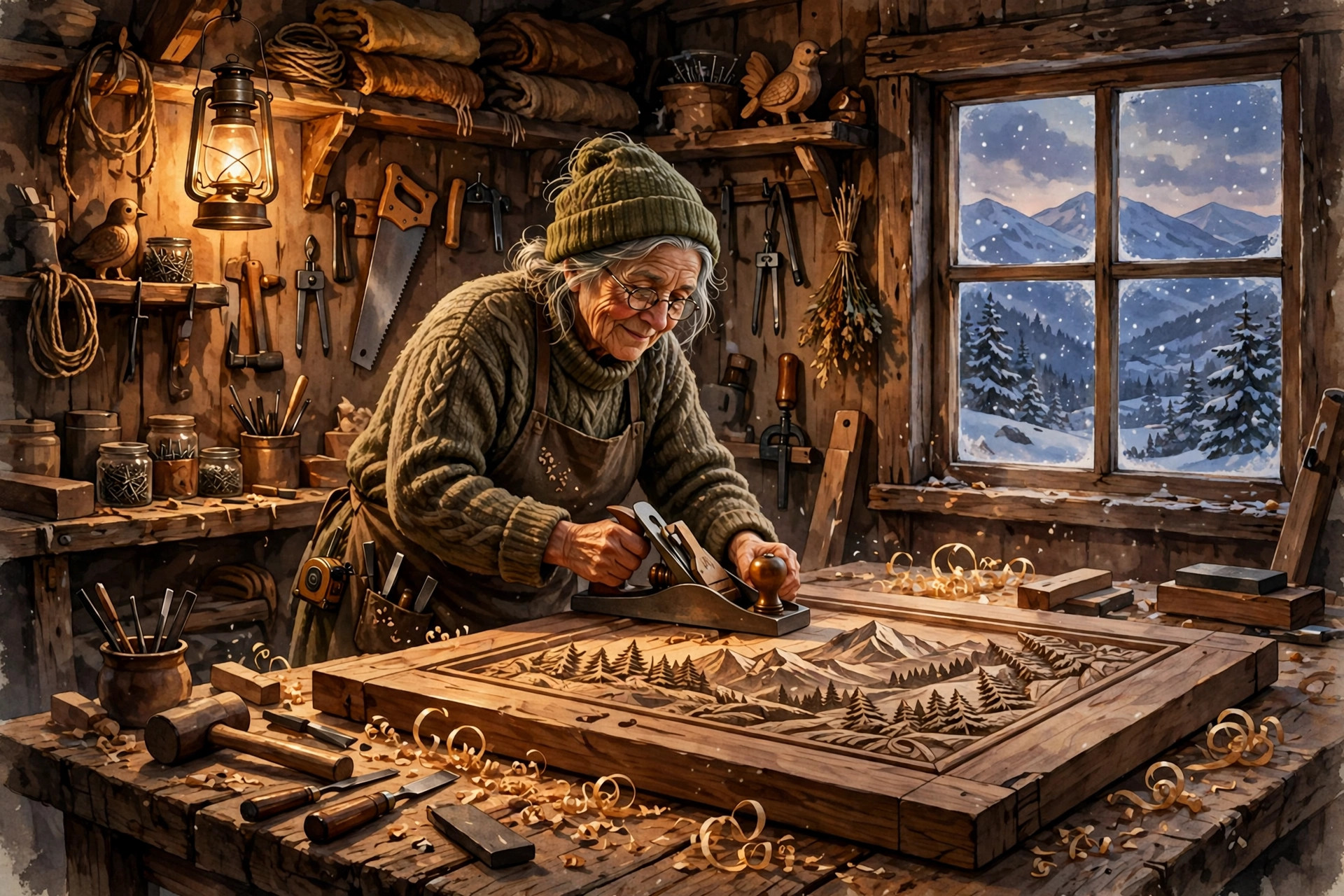
The most enduring stories of humility are never about grand gestures — they are about quiet people doing excellent work and asking for nothing in return. The Unsigned Doors is an original wisdom story about a young builder who carved his name in letters a foot tall, and the old carpenter who taught him what a name is actually worth. Readers who loved learning to set down pride and keep only what matters will find a kindred lesson here.
The Unsigned Doors
In the mountain town of Halder’s Gate, every door worth having was made by Mara — and not one of them bore her name.
The inn’s great oak door, carved with pinecones. The chapel’s double doors, which had swung open and shut for sixty years without a squeak. The little blue door of the schoolhouse, worn smooth at the handle by ten thousand small hands. All Mara’s work. She built them in her workshop behind the mill, sanded each hinge herself, and hung them in silence. When people thanked her, she would only shrug and say, “A door is not about the maker. It is about everyone who will pass through it.”
Then came Dren.
Dren was twenty-six, trained in the capital, and famous before he arrived — at least in his own telling. He had come to Halder’s Gate to build the new assembly hall, and he intended everyone within fifty miles to know it. He hired the finest stone, the tallest beams, and on the day the hall opened, the whole town gathered to see what he had carved above the main entrance: DREN — MASTER BUILDER, in letters a foot tall.
“Beautiful,” said the mayor, squinting up at it.
“Unforgettable,” Dren agreed, and meant himself.
That winter, the worst storm in living memory buried Halder’s Gate. Snow piled against walls, roofs groaned, and in the third week of it, with a sound like a giant clearing its throat, the grand assembly hall’s roof sagged and split down the middle. Dren had built it for admiration — broad spans, thin supports, no wasted timber on bracing nobody would see. Nobody was inside, thank heaven. But the town’s pride lay open to the sky, and Dren’s great carved name stood over a ruin.
The townspeople did what mountain people do: they opened their homes. Neighbors crowded into kitchens and parlors, and every single one of those rooms was entered through one of Mara’s unsigned doors. They held. They had always held.
On the coldest night, Dren walked the empty streets alone and found Mara in her workshop, planing a replacement door for the chapel, which the storm had warped. Her lantern threw warm light across the shavings curling off her blade.
“They will laugh at me,” Dren said. “My hall fell. My name is carved over a collapse.”
Mara didn’t look up. “Names carved in stone fall with the stone.”
“You never sign anything,” he said. “Don’t you want anyone to know?”
She set down the plane and finally looked at him — not unkindly.
“Sixty years of doors, and I am known in every house in this town,” she said. “The innkeeper knows my work. The schoolchildren know it, though they don’t know my name. A door that holds through a storm tells people everything about its maker except the one thing that never mattered.”
Dren was quiet for a long time. Then he picked up a spare chisel from her bench.
“May I help?” he asked.
She smiled and handed him the plane.
He stayed through the spring, learning to cut a mortise properly — the slow way, the hidden way, the way nobody applauds. When the assembly hall was rebuilt, it was smaller, plainer, and braced like a fortress. Above the door there was no name. Dren never carved another one.
Years later, when travelers asked who had built the fine hall of Halder’s Gate, the townspeople would answer the way Mara had taught them: “Someone who learned that a name carved in wood rots, but a door that shelters people stands.”
The Moral of the Story
Humility is not thinking less of yourself — it is thinking of yourself less. Like the cracked cup that taught its owner to value usefulness over perfection, Mara’s doors remind us that the work which serves others outlives the name attached to it. Build for the people who will pass through, not for the applause of those watching.
Think About It
- Where in your life are you carving your name in letters a foot tall — and what would change if you built quietly instead?
- Who is the “Mara” in your world: someone doing excellent, unnoticed work?
- What is one thing you could do this week purely for others, with no credit attached?
Frequently Asked Questions
What are stories of humility?
Stories of humility are short inspirational tales about characters who learn to set pride aside — often discovering that quiet service and excellence matter more than recognition. They are a beloved branch of wisdom stories because the lesson is felt, not preached.
What is the moral of “The Unsigned Doors”?
The moral is that humility means thinking of yourself less: work done to serve others outlasts any name carved on it. A door that shelters people through a storm says everything about its maker except the one thing that never mattered.
Why do humility stories resonate with adult readers?
Adults live in a world that rewards visibility — titles, followers, credit. Stories of humility offer a counterweight: the reminder that the most meaningful work is often unsigned, and that a quiet life of service leaves the deepest mark.