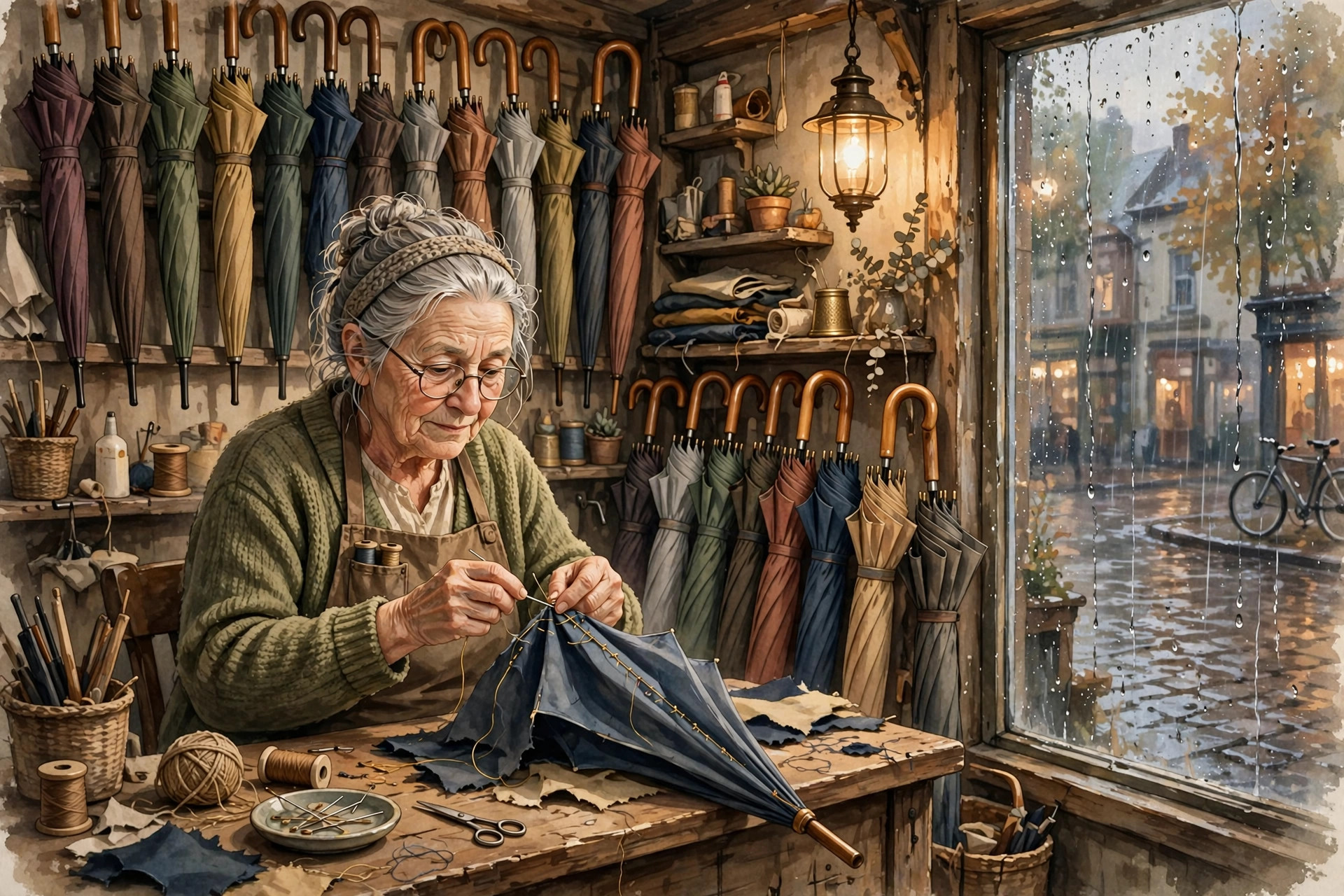
If you enjoy reading moral stories in English, here is an original one written just for you. The Umbrella Maker is a short inspirational story about quiet, patient work — and how a lifetime of small, careful acts can shelter far more people than we will ever know.
The Umbrella Maker
On the corner of Willow Lane, between a bakery and a bookshop, sat the smallest shop on the street. Its wooden sign read simply: “A. RAIN — UMBRELLAS MENDED.”
Amara Rain was eighty-one years old, and she had mended umbrellas for fifty-four years. Each autumn the rain lashed her shop windows, and each autumn the people came: with torn canopies, snapped ribs, handles hanging by a thread. Amara would take each umbrella the way a doctor takes a wrist — gently, and with complete attention.
She never hurried. “An umbrella is a promise,” she liked to say. “It promises one dry walk home. You cannot rush a promise.”
One October morning, a young man burst through her door, shaking rain from his coat. His name was Dev. He was twenty-six, and he had the most important job interview of his life in forty minutes — across town, in weather that had turned the streets into rivers.
“Please,” he said, holding out his umbrella. A spoke had snapped clean through the fabric. “Can you fix it? I’ll pay double. Triple.”
Amara studied the umbrella, then studied him. “Sit down,” she said. “There’s tea.”
“I don’t have time for tea!”
“You have time for what matters,” she said, and set a chipped blue cup in front of him.
As she worked — needle flashing, fingers steady despite their age — Dev tapped his foot and checked his phone every thirty seconds. The rain hammered the glass. His big chance was slipping away with every minute.
“You are angry at the rain,” Amara observed, without looking up.
“I’m angry at everything today.”
She smiled. “Let me show you something.” She pulled a thick, leather-bound ledger from under the counter and slid it across. Page after page, in neat handwriting: names, dates, small notes. “Mrs. Okafor — wedding, June 1998 — canopy re-stitched.” “Schoolboy, name unknown — exam morning, 2004 — handle replaced.”
“Fifty-four years of umbrellas,” she said. “Every one a person who needed to get somewhere dry. I have never met most of them. I never will. But I know this: somewhere out there, thousands of walks home happened because of these hands.”
She tied off the final stitch and held up Dev’s umbrella. Whole again.
“Your interview,” she said, “is one walk. The rain is not your enemy, young man. It is only weather. What matters is that you arrive — calm, dry, and kind. Jobs come and go. The way you carry yourself through the storm is what people remember.”
Dev looked at the clock. He had twenty minutes. He drank the tea in three gulps, paid her, and ran — then stopped in the doorway and turned back.
“How many umbrellas?” he asked. “In the ledger. How many?”
“Forty-one thousand, two hundred and six,” she said. “Yours makes forty-one thousand, two hundred and seven.”
He laughed — the first real laugh of his rainy morning — and stepped out into the storm, dry beneath his mended promise.
He got the job, by the way. But that is not the point of this story. The point is what he did the following spring: he returned to Willow Lane with a new ledger — blank pages, good leather — and placed it on Amara’s counter.
“For the next fifty-four years,” he said.
Amara opened it to the first page and wrote, in her neat hand: “Dev — interview morning — reminded me why I mend.”
Some people change the world with grand gestures. Amara Rain changed it one stitch at a time, forty-one thousand times over — proving that the smallest work, done with love, shelters more than we will ever know.
The Moral of the Story
Great impact rarely comes from grand gestures. It comes from small, careful work repeated with love — one stitch, one umbrella, one dry walk home at a time. You may never meet the people your work shelters, but shelter them anyway.
Think About It
- What is the “small work” in your life that you might be undervaluing?
- Who has quietly sheltered you through a storm — and have you thanked them?
- How would your work change if you treated every task as a promise to a stranger?
Frequently Asked Questions
What is the moral of “The Umbrella Maker”?
The moral is that small, careful work done with love has an enormous quiet impact — like an umbrella mender whose forty-one thousand stitches sheltered thousands of strangers she never met.
Why read moral stories in English?
Reading moral stories in English is a wonderful way to enjoy meaningful fiction while naturally improving your language skills. Short stories with clear lessons build vocabulary, comprehension, and a love of reading at the same time.
Are the stories on Brief Tellings original?
Yes. Every story on Brief Tellings is written fresh by our team — original fiction created for this site, never copied or retold from existing published tales.