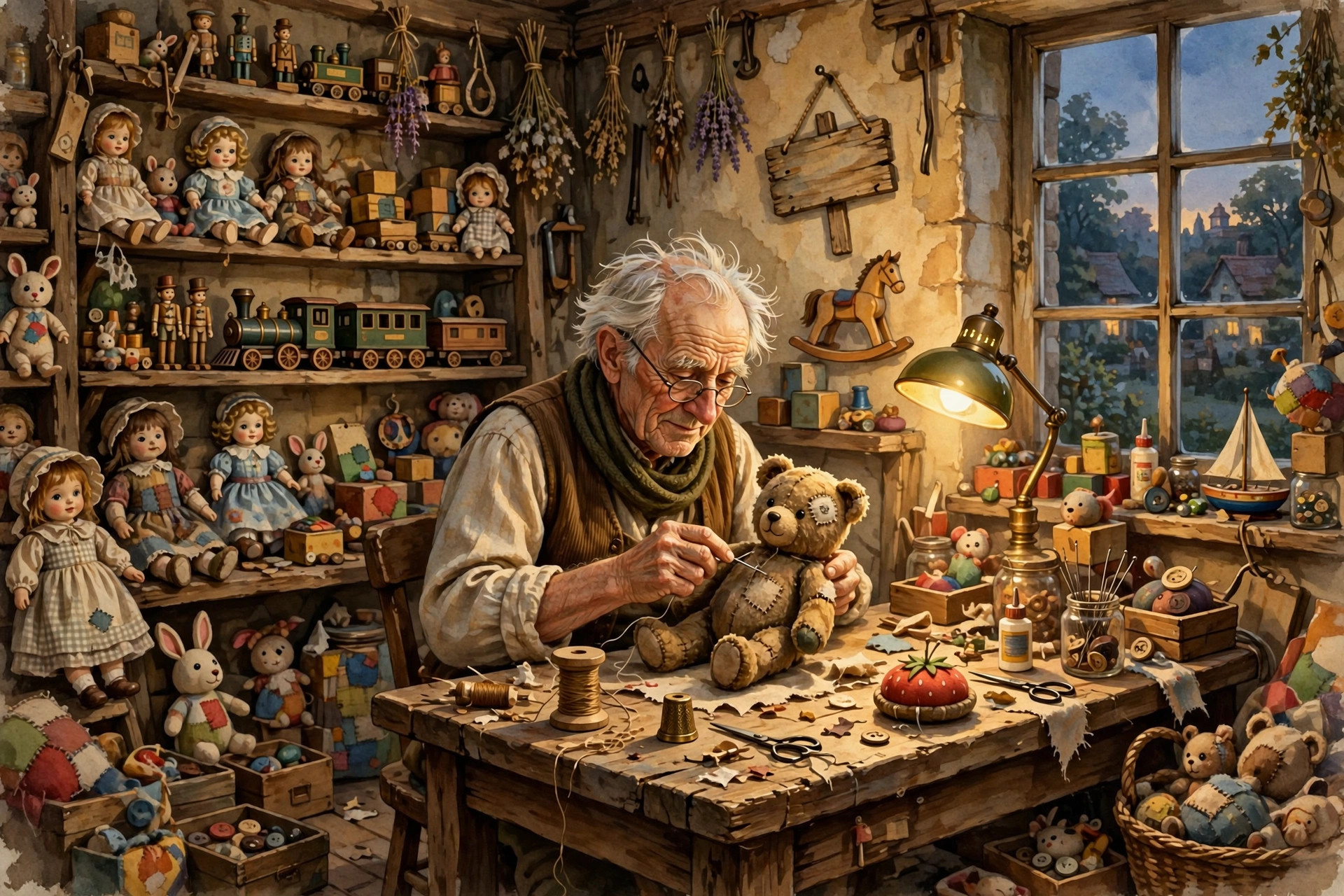
Among the finest English stories with a moral, the best ones remind us that generosity is never wasted. The Toy Mender is one such tale — about an old repairman who fixed broken toys for free, and the day the whole town decided to mend something for him.
The Toy Mender
Elias Brandt’s shop sat on the corner of Willow and Third, in the kind of street where the paint peels a little and nobody minds. Above the door, a wooden sign read simply: ELIAS — TOYS MENDED. The sign was crooked. The hinges squeaked. Inside, it smelled of wood glue and warm dust.
Elias was seventy-four, and he had mended toys for fifty years. Dolls with torn seams. Trains with missing wheels. A teddy bear that had been through a flood and come out the other side smelling faintly of river. He could fix almost anything — except, he liked to say, a toy that had never been loved, because those didn’t break. They just got put away.
There was one rule in Elias’s shop, written on a small card by the till:
“No charge for children’s toys. Broken things deserve a second chance.”
He never advertised the rule. Children simply learned it the way children learn everything — by watching. A boy with a snapped kite string. A girl whose doll’s arm hung by a thread. They would push open the door, and Elias would look over his spectacles and say, “Let’s have a look, then,” and the toy would come back to life on his workbench while the child sat on the stool, swinging their legs.
He charged adults, of course — a few coins for a clock, a little more for a chair leg. It was never much. Elias had never been rich. But he had never been hungry either, and that was enough.
Until the letter came.
The landlord — a property company three cities away — was raising the rent. Double. The letter was polite and final. Elias read it twice, folded it into his apron pocket, and went back to stitching a doll’s dress. That evening, he told his neighbour, Mrs. Anand, “Sixty years on this street. I suppose the street has other plans.”
Mrs. Anand told the baker. The baker told the postman. The postman, who had once watched Elias re-string his son’s cricket bat for free, told everyone else.
Three days later, a man in a good coat walked into the shop. He looked around at the shelves of rescued toys and said, “I’m with the property company. We’d like to help you relocate. There’s a smaller unit two streets over.”
“Thank you, but no,” Elias said, gluing a wooden wheel. “This is where the shop belongs.”
The man smiled the way people smile when they think they are being kind. “With respect, sir, sentiment doesn’t pay rent. The building is worth more as retail space.”
Elias nodded. He did not argue. That night, he packed his tools slowly, the way a man packs a lifetime.
But the town had other plans.
On Saturday morning, Mrs. Anand knocked on his door with an envelope. Inside were banknotes — more than Elias had seen in years. “From all of us,” she said. “Every family on this street. You remember my daughter’s doll? The one with the blue dress? She still has it. She’s twenty-six now.”
By noon, the whole street had gathered outside the shop. The baker brought bread. The postman brought his son — now a young man, carrying the cricket bat Elias had mended a decade ago, still in playing shape. One by one, people came forward with the toys Elias had saved: dolls, trains, bears, kites. They lined them up along the shop window, a small army of second chances.
And then the man in the good coat arrived — the one from the property company. He stood at the back of the crowd, watching. After a while, he stepped forward and handed Elias a folded paper.
“The company has reconsidered,” he said quietly. “Your rent is frozen at the old rate. For as long as you want the shop.”
Elias blinked. “Why?”
The man looked at the row of mended toys in the window. “My daughter’s bear,” he said. “The one with the missing ear. You sewed it back on in 1998. She named it after you — calls it Elias. She still sleeps with it when she visits.”
He paused. “I didn’t recognise the shop at first. I didn’t recognise you. Forgive me.”
Elias smiled the slow smile of a man who had been mending things for fifty years. “Broken things deserve a second chance,” he said. “People too.”
The shop stayed. The sign stayed crooked. And in the years that followed, children kept pushing open that door, and Elias kept saying, “Let’s have a look, then” — because kindness is a chain, and every link matters. He had learned, long ago, that it is never too late to begin being generous — and that what you give away for free is often what comes back to you, a hundred times over.
The Moral of the Story
Generosity is never wasted. Elias gave away his work freely for fifty years, asking nothing in return — and when he needed help, the kindness he had scattered came back multiplied. True wealth is not measured in what you keep, but in what you give.
Think About It
- What is something you do for others without expecting payment or praise — and what does it give you back?
- Who once helped you “for free,” and have you ever told them what it meant?
- If your community gathered to thank you, what would they line up on your window?
Frequently Asked Questions
What is the moral of “The Toy Mender”?
The moral is that generosity always returns. Elias mended children’s toys for free for fifty years, and when his shop was threatened, the kindness he had given freely came back to save him.
Why are English stories with a moral so popular with adult readers?
English stories with a moral give adults a short, memorable way to reflect on values like kindness, honesty, and resilience. A simple narrative often reaches the heart faster than advice — which is why these stories are shared in classrooms, workplaces, and homes alike.
How can I apply the lesson of “The Toy Mender” in everyday life?
Do one small thing for someone today without expecting anything back — fix something, listen, help, share. Kindness is a chain: every quiet act of generosity makes the next one more likely, in you and in others.
More Stories You’ll Love
- The Lantern Keeper — a touching story about quiet kindness and the chain it creates.
- The Marble Jar — a simple tale about honesty and the small things that make us rich.
- The Button Box — a heartwarming story about gratitude and what we leave behind.