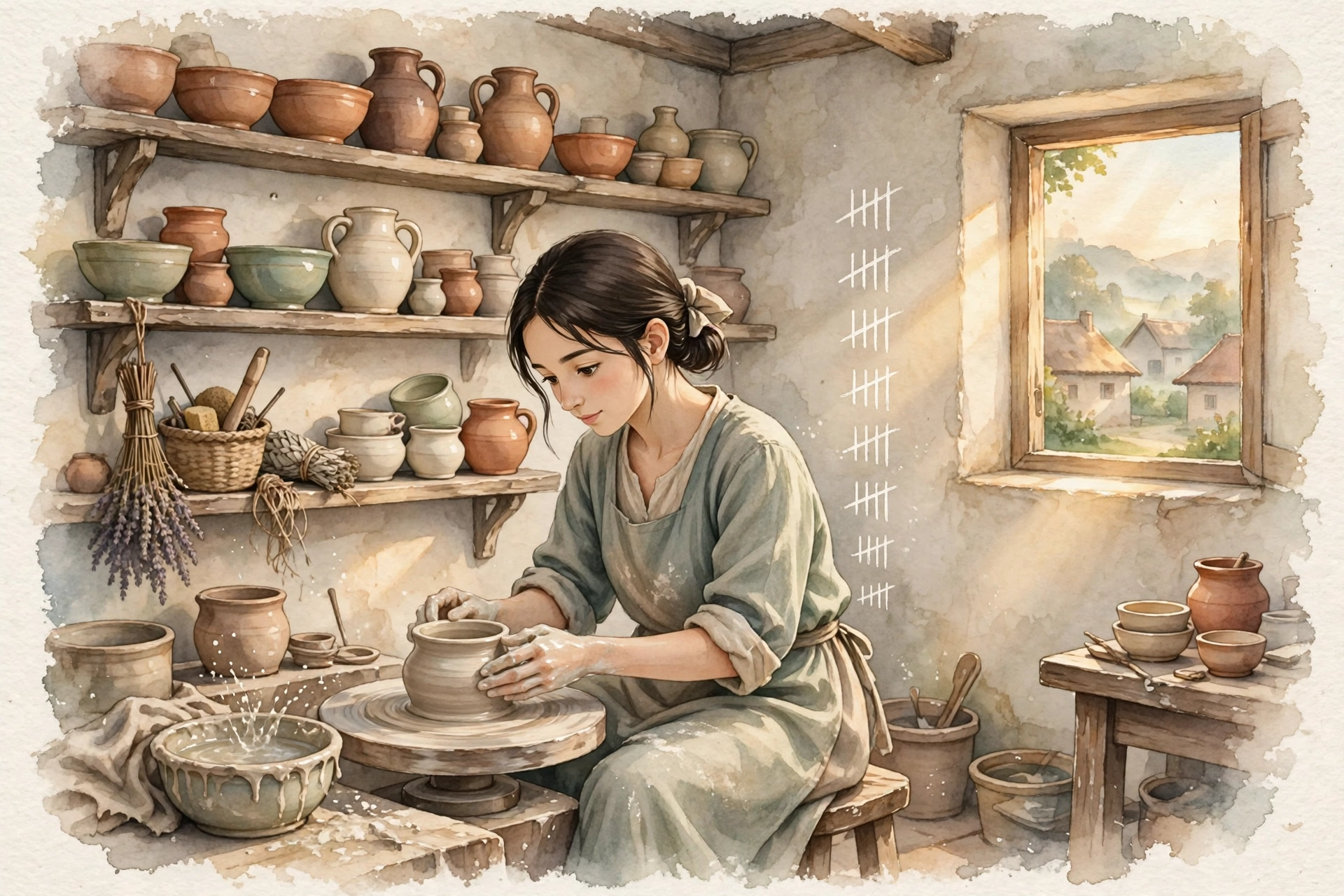
A short story about self discipline is a story about keeping a small promise to yourself every single day, even when no one is watching. This is the story of Mara, a young potter’s apprentice who was given one simple task — throw a single pot each morning — and discovered what a hundred quiet mornings can build.
The Potter’s Hundred Days
In the village of Alderbrook, the potter’s workshop stood at the end of the lane, its chimney always smoking. Master Tobin had thrown pots there for forty years, and his bowls sat on every table in the valley. When Mara, seventeen and restless, begged him to take her on as his apprentice, he agreed — on one condition.
“One pot,” he said. “Every morning, before anything else, you will throw one pot. Not two. Not none. One. On the days you feel like it, and on the days you do not. That is the whole of the craft.”
Mara laughed. She had expected long lectures and secret techniques. Instead she got a single pot a day, and a piece of chalk. “Mark each morning on the wall,” Tobin said, pointing at the plaster beside the wheel. “One line for every pot. Do not count the days ahead. Count only the line you draw today.”
The first week was easy. Mara arrived before sunrise, her hands cold, the clay colder, and threw her pot while the village slept. The pots were lopsided and thick, but each morning she drew her line, and the row of marks grew.
By the third week, the novelty had worn off. Rain hammered the roof for days, and the workshop was damp and grey. One morning Mara’s hands ached from the cold, and the clay collapsed twice on the wheel. She stared at the ruined lump and thought of her warm bed. No one would know, she thought — Tobin slept late. No one would ever know if she skipped a single morning.
She threw the pot anyway. It was ugly — the worst yet — but she set it on the shelf with the others and drew her line on the wall. “The pot is not the point,” Tobin said that afternoon, nodding at the shelf. She had not realised he had been watching. “The line is the point.”
On the fortieth morning, a travelling merchant stopped at the workshop and laughed at the shelf of crooked pots. “You keep all of them?” he asked. “Even the ugly ones?” Mara felt her cheeks burn. “Every one,” Tobin answered. “They are not pots. They are mornings.”
Something shifted in Mara after that. She stopped hurrying. She began to notice the small things: how the clay felt different on wet mornings, how a slower wheel made a steadier wall, how her hands knew things her mind had not yet named. The pots grew straighter and thinner. She no longer threw a pot to finish a task — she threw it because the morning asked for one.
On the seventieth morning, snow covered Alderbrook, and the path to the workshop was drifted shut. Mara waded through it, lantern in hand, and found Tobin already there, stoking the kiln. “I thought you might stay in bed today,” he said. “I thought about it,” Mara admitted. “And then I came anyway.” Tobin smiled. “That is the whole of it,” he said. “Thinking about it, and coming anyway.”
On the hundredth morning, the light was gold. Mara sat at the wheel, centred the clay, and threw her hundredth pot. Her hands moved without thinking — pull, shape, smooth, release — and when she lifted it from the wheel, it was the finest thing she had ever made: thin as an eggshell, steady as a held breath.
She carried it to the shelf and set it beside the very first pot, lopsided and thick. Side by side, they told the whole story. Tobin looked at them, then at the wall, where a hundred chalk lines stood in a row like a small white fence. “Now,” he said, “you are a potter. Not because of the hundredth pot. Because of the ninety-nine mornings that came before it.”
Mara still throws one pot every morning. Some days it is beautiful; some days it is not. But the line goes on the wall either way — because discipline is not doing something perfectly. It is doing it again tomorrow.
The Moral of the Story
This short story about self discipline is not about willpower or punishment — it is about a promise so small you cannot fail it. Mara did not become a potter by waiting for inspiration or by working in great bursts. She became one by throwing a single pot each morning, even on the cold, grey days when no one was watching. Like the compass maker who found his purpose by walking beside someone who needed him, she learned that the big change comes from the small thing done daily. Discipline is not a grand gesture. It is a line on the wall, drawn one morning at a time.
Think About It
- What is one small promise you could keep every day — so small you could not fail it?
- When have you skipped something because no one would know? What would change if you did it anyway?
- What would your own wall of a hundred lines look like — and what would stand at the end of it?
Frequently Asked Questions
What is self discipline?
Self discipline is the ability to keep a promise to yourself, especially when you do not feel like it. It means doing the small, useful thing at the time you said you would, rather than waiting for motivation. A disciplined person acts first and lets the feeling follow the action.
What is the moral of “The Potter’s Hundred Days”?
The moral is that discipline is built one small promise at a time. Mara became a potter not through talent, but by throwing one pot every morning for a hundred days. The hundredth pot was beautiful only because the ninety-nine before it had taught her hands. Small daily effort is what turns a beginner into a craftsperson.
How can I build self discipline in daily life?
Start with one promise so small you cannot fail it — five minutes, one page, one pot. Do it at the same time every day, and mark each day on a wall or calendar so the chain grows. On hard days, do the smallest version. A kept streak teaches you that you are someone who keeps promises.
Why does self discipline matter more than motivation?
Motivation comes and goes with mood, weather, and sleep, but discipline stays. Mara threw pots on cold, rainy mornings when she felt nothing at all — and those were the mornings that taught her most. Motivation can start a habit, but only discipline carries it through the dull middle, where real skill is quietly made.