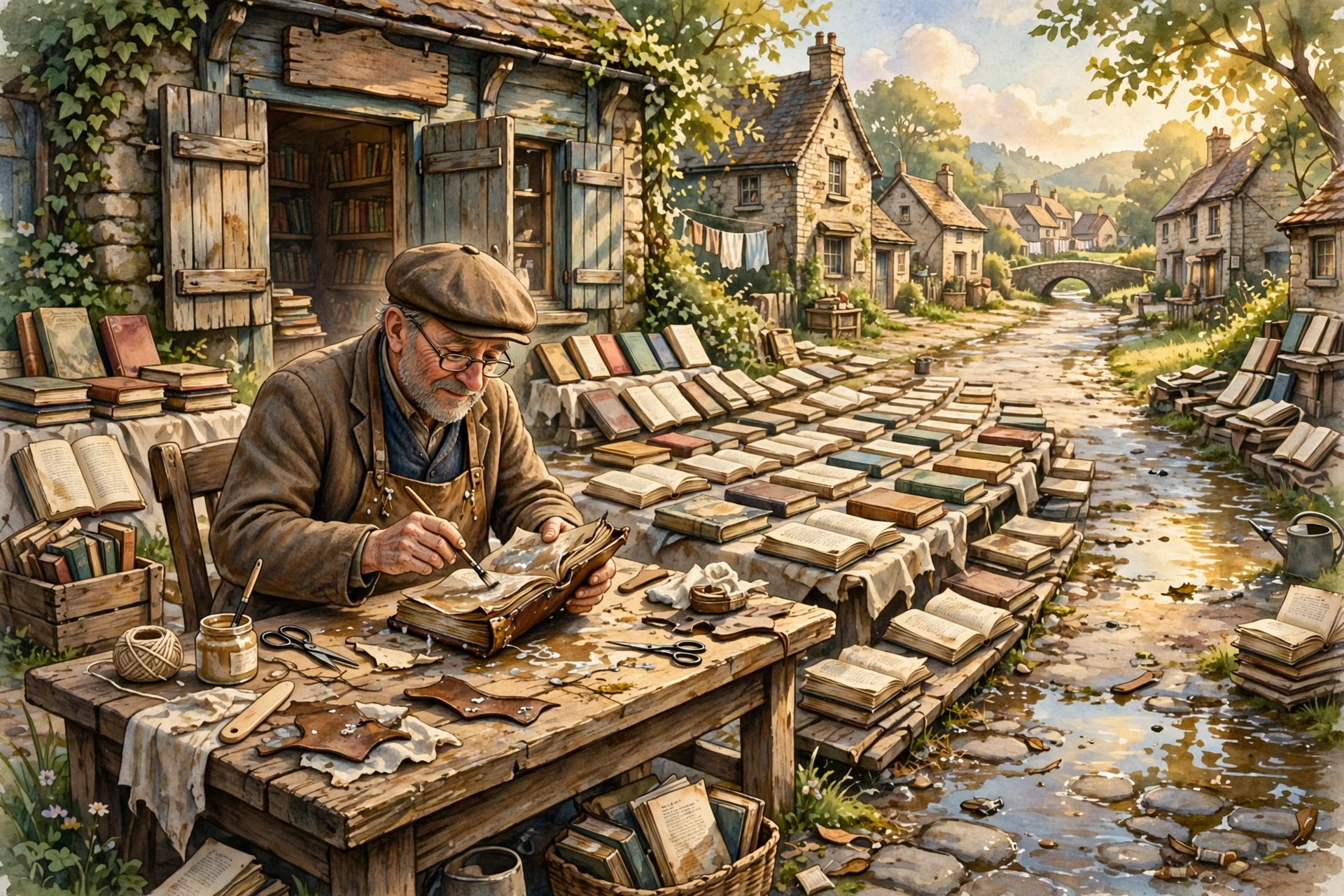
Some of the most moving stories based on a true story are not about famous heroes at all. They are about ordinary people who, when everything is washed away, quietly pick up one small thing and begin again. The Bookbinder of Willow Lane is an original story in that spirit — about an old craftsman, a flood, and the books that carried a whole street back to hope.
The Bookbinder of Willow Lane
Amos Bell had bound books on Willow Lane for fifty-one years. His shop was small and smelled of glue, paper, and rain. Shelves lined the walls from floor to ceiling, and on the counter sat a brass press older than Amos himself. People brought him cookbooks held together with tape, schoolbooks with torn spines, and Bibles whose covers had been loved thin. He mended them all, slowly, by hand, and charged whatever people could pay.
Then, one September night, the river rose.
By morning, Willow Lane was under brown water. Amos waded back to his shop at dawn, his trousers soaked to the knee, and found his life’s work floating. Hundreds of books lay swollen and mud-streaked on the floor. The brass press stood in a puddle. The shelves sagged like tired shoulders.
Neighbours gathered outside, carrying what they had saved. Mrs. Doyle held a dripping photo album. Young Karim clutched his schoolbag. Old Mr. Finch, who had lost his wife the winter before, stood silently holding a hymn book — the one she used to sing from every Sunday.
“It’s gone, Amos,” someone whispered. “All of it.”
Amos looked at the ruined shop for a long time. Then he rolled up his sleeves, pulled a single chair into the doorway where the sun could reach it, and sat down with Mr. Finch’s hymn book in his lap.
“Not all of it,” he said. “This one can be saved. One page at a time.”
He worked the way he had always worked: gently, without hurry. He separated the stuck pages with a thin knife, laid them in the sun to dry, and pressed them flat between clean boards. While the pages dried, he told Karim about the first book he had ever bound, a geography book for a boy who could not afford a new one. While the glue set, he listened to Mrs. Doyle talk about the wedding photographs pressed inside her album.
Word spread down the lane. If Amos could save one book, perhaps he could save another. People began bringing him their sodden treasures — a child’s storybook, a recipe book in a grandmother’s handwriting, a poetry collection with notes in the margins. He set up a long table in the sun outside his shop and taught anyone who would sit with him how to dry a page, how to stitch a spine, how to press a cover flat.
It was slow work. Some books were too far gone, and Amos was honest about those. “We keep the memory, even when we cannot keep the pages,” he would say, and he would help the owner copy out a favourite passage by hand into a fresh notebook.
Weeks passed. The water went down. The lane was cleaned, house by house, and in the window of the little shop, a row of rescued books began to appear — not perfect, not new, but whole. Their covers bore faint watermarks, like thin lines on a map, showing exactly where they had been.
On the first Sunday after the flood, Mr. Finch stood in the church doorway with his hymn book open, its pages a little wavy, its spine newly stitched. When the congregation sang, his voice, which had been silent all winter, rose with the others — unsteady at first, then strong.
After the service, he walked to the shop and shook Amos’s hand for a long time. “You didn’t just mend my book,” he said. “You gave me back the Sundays I thought I’d lost.”
Amos smiled, the way a man smiles when a long job is finally done. “A book is never just paper,” he said. “It is every hand that held it. As long as one page survives, the story goes on — and so do we.”
That winter, a new sign appeared above the shop door, painted by Karim in careful letters: Amos Bell, Bookbinder — We Mend What Matters. Beneath it, people still bring their damaged books, and Amos still mends them, one page at a time, proving that a second chance is not something you wait for. It is something you stitch together, with patience and quiet kindness, until it holds again.
The Moral of the Story
When disaster takes almost everything, hope returns the way Amos restored his books: one page at a time. You do not need to fix the whole street in a day. Save what you can, help the person beside you save theirs, and the story — and the community — will hold together again.
Think About It
- What is one “damaged book” in your own life — a habit, a relationship, a dream — that is worth mending one page at a time?
- Who around you might be quietly waiting for someone to sit beside them and begin the slow repair?
- How would your week change if, instead of mourning what is lost, you asked: what can still be saved?
Frequently Asked Questions
Is “The Bookbinder of Willow Lane” a true story?
No — it is an original story written for Brief Tellings, in the spirit of stories based on a true story. Its flood, its bookbinder, and its street are fictional, but the resilience it describes — neighbours rebuilding together, one small repair at a time — is real and happens in communities everywhere.
Why do stories based on a true story inspire us so much?
Because they show ordinary people facing real loss and choosing to keep going. When a story feels true to life, its lesson feels possible for us too: if Amos can begin with a single page, we can begin with a single step.
What is the moral of “The Bookbinder of Willow Lane”?
The moral is that hope is rebuilt slowly, by hand, together. Save what you can, help others save what they can, and even a damaged story can hold together again.