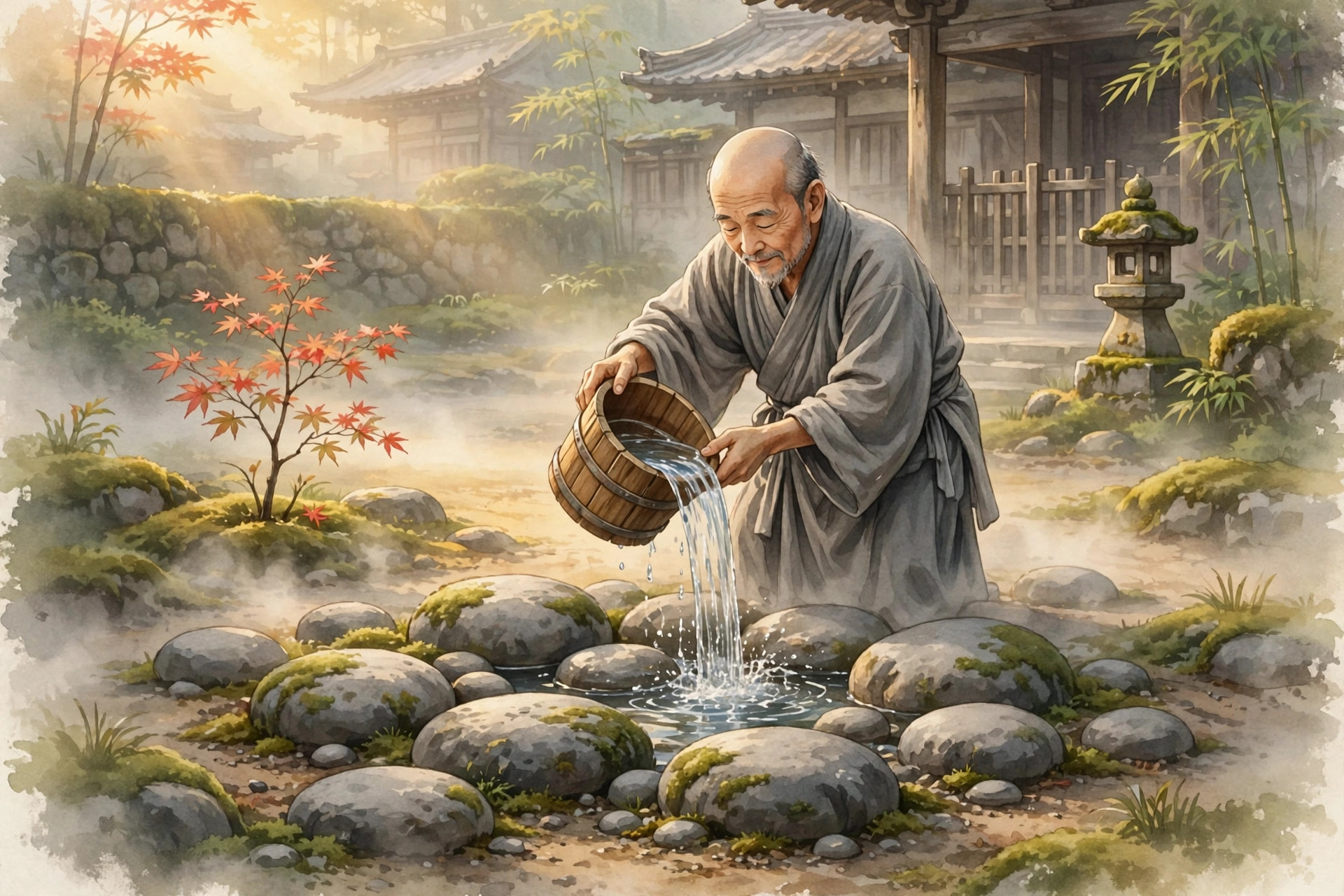
The best zen parables never raise their voice. They arrive like morning mist — quiet, simple, and somehow impossible to forget. The Gardener of Stones is one such tale: an original short story about an old monk, a patch of bare rock, and the patient kind of effort that teaches the mind to be still.
The Gardener of Stones
At the edge of the mountain temple, beyond the pine grove where the novices gathered firewood, lay a small courtyard no visitor ever noticed. It had no flowers, no pond, no ornamental lantern. Only stones — smooth, grey river stones, spread across the packed earth like a dry riverbed waiting for rain that never came.
And every morning before the sun cleared the ridge, old Master Genko walked out there with a wooden bucket and watered them.
Kaito, the youngest novice, watched him for three weeks before his curiosity got the better of him. The boy was sixteen, quick-minded, and quietly certain that everything in life had a reason — a reason he was usually smart enough to find.
“Master,” he asked one dawn, falling into step beside the old man, “the flowers by the gate — they are watered. The herbs behind the kitchen — watered. But these stones… they will not grow. What is the point?”
Genko tipped the last of the bucket over a broad flat stone and watched the water run off its edges.
“Tell me,” he said, “what grows here?”
Kaito frowned. “Nothing. That is my question.”
“Then sit and look,” said the master, “and you will have your answer.”
Kaito sat. The old man finished his rounds and walked back inside, leaving the boy with the wet stones and his irritation. Stones did not need water. This was not wisdom; this was stubbornness wearing a robe.
But Kaito was not one to leave a question unanswered, so he decided to fix the courtyard himself. That afternoon he carried away the ugliest stones and planted a young maple sapling in the richest patch of soil beneath them. When Genko came out the next morning with his bucket, he stopped, looked at the sapling, and nodded once — and watered the remaining stones exactly as before.
Weeks passed. The maple grew. Kaito felt quietly triumphant, and also a little embarrassed: surely the master had noticed the improvement.
One morning, Genko set down his bucket and said, “The maple is lovely, Kaito. But tell me — have you noticed the stones?”
“They are the same as ever, Master.”
“Look closer.”
Kaito knelt. And on the north side of the largest stone, where the morning water pooled before running off, there was a patch of green — soft as breath, small as a fingernail.
Moss.
“Three months of water,” Genko said, “and the hardest thing in this courtyard is learning to hold something soft.”
Something loosened in Kaito’s chest. He understood, all at once, that he had been the stone: hard, quick, certain that effort was only effort if it produced something visible — a sapling, a result, a thing to point at. The master had not watered the stones to change the stones. He had watered them to change the one who watched.
From that day, Kaito rose before the bell and carried the second bucket himself. He learned the names of the winds that crossed the courtyard. He watched the moss spread across the stones like slow green handwriting, one season’s patience at a time.
And years later, when the temple sent him to the valley to teach, the villagers would ask why he was so unhurried — why he never forced a lesson, never hurried a student, never despaired at a slow mind. He would smile and tell them about a patch of bare stones, and about the quiet truth he had learned there: gentleness, repeated daily, can soften anything — even stone, even a stubborn heart.
The maple still stands by the courtyard. The moss still grows. And somewhere, every morning, an old bucket empties over grey stones that are still, technically, just stones.
But ask anyone who has sat with them long enough, and they will tell you: the stones are not the same. Neither are they.
The Moral of the Story
Patience is not waiting — it is the small daily act repeated without demanding results. Like the old monk’s water, gentleness applied steadily softens what force never could: a stubborn heart, a slow learner, or your own restless mind.
Think About It
- Where in your life have you given up on something simply because the results were not visible yet?
- What is one small, quiet effort you could repeat daily — for a whole season — without expecting applause?
- Is there a “stone” in your life — a hard habit, a difficult relationship, your own impatience — that needs watering rather than striking?
Frequently Asked Questions
What are zen parables?
Zen parables are short, simple stories from the Zen tradition that point to deep truths about mindfulness, patience, and letting go. Rather than explaining the lesson, a zen parable lets the reader discover it — like morning mist clearing on its own. Tending small things with gentle care is one of their most beloved themes.
What is the moral of “The Gardener of Stones”?
The story teaches that patient, repeated small efforts — like watering stones until moss grows — can soften anything over time. Lasting change rarely comes from force; it comes from gentle consistency, applied without demanding immediate results.
Are these zen stories original?
Yes. Every story on Brief Tellings is written fresh by our writers — original fiction inspired by Zen themes, never copied from published collections or ancient texts.